According to recent McKinsey research, demand for AI fluency has grown 7x in just two years. AI literacy is quickly becoming essential for staying relevant in today’s job market.
So, if you’ve already decided to build your AI skills, great! You’re on the right track. But where should you begin? I’ve curated a list of the Best Free AI Courses for Beginners in 2026 to help you take that first step with confidence.
No matter if you’re a complete beginner, a developer, a non-tech professional, or simply looking to upskill, there’s something here for everyone. These courses are offered by trusted names like Google, DeepLearning.AI, Hugging Face, and more, so you’ll be learning from some of the best in the industry.
Let’s find the perfect course!
- Why Learn About AI?
- The Best Free AI Courses for Beginners [Quick Comparison]
- The Best Free AI Courses for Beginners
- Best Courses to Learn ChatGPT & Conversational AI
- Best Free Prompt Engineering Courses
- Best Courses for Generative AI
- Best free LLM and model-building track AI course
- Best free AI agents and workflows courses
- Best free AI courses for Vibe Coding
- Conclusion
Why Learn About AI?
AI is today’s reality, and the field is advancing every day! And those who don’t know and adapt to it risk falling behind. Today, AI tools are being used across various domains, such as academics, marketing, creative work, and more.
For example, generative AI is helping beginner graphic designers create stunning digital art. Meanwhile, creators are using AI for content research, brainstorming ideas, writing captions, scripting videos, and much more.
So, if you’re still a beginner, don’t worry! With beginner-friendly AI courses, you can quickly build your skills, boost your productivity, and save time and effort. It’s never too late to get ahead with AI.
The Best Free AI Courses for Beginners [Quick Comparison]
| Course Name | Hosting Platform | Duration | Format | Certificate | Best for |
| Elements of AI | University of Helsinki / MinnaLearn | ~30-40 hrs (6 chapters, 2 parts) | Self-paced, text + quizzes | Free (paid option for university credit) | True beginners |
| Google AI Essentials | Google (Coursera) | <5hours (5 modules) | Video + interactive exercises | Free, shareable certificate | Non-technical learners |
| CS50x 2026: Artificial Intelligence | Harvard (edX) | ~1 hour | Video | Free to audit; paid verified certificate on the entire CS50 course completion | Learners ready to go deep into AI theory |
| Introduction to Prompt Engineering and Advanced Prompt Engineering | OpenAI Academy | ~15 min | Short videos | No | Learning Prompting techniques |
| Prompt Engineering for ChatGPT | Vanderbilt University (Coursera) | ~18 hours | Video + text + assignments | Free to audit; paid certificate | Structured, academic approach to prompting |
| ChatGPT Prompt Engineering for Developers | DeepLearning.AI / OpenAI | ~1.5 hrs | Short video course + Jupyter notebooks | Free to audit; paid certificate | Coders who want to build with the OpenAI API |
| Generative AI for Everyone | DeepLearning.AI / Andrew Ng (Coursera) | ~5-6 hrs | Video + text + assignments | Free to audit; paid certificate | Non-technical understanding |
| Hugging Face LLM Course | Hugging Face | ~40-60 hrs (self-paced) | Interactive notebooks + text | No | Learners who want to understand open-source LLMs |
| LLM Course by Andrej Karpathy | Andrej Karpathy (YouTube) | ~3 hrs (single deep-dive video) | Long-form YouTube video | No | Technical learners |
| Claude Code in Action | Anthropic Academy (Skilljar) | ~1 hour | Video + hands-on exercises | Free, official Anthropic certificate | Developers wanting to use Claude Code |
| Hugging Face Agent Course | Hugging Face | ~30-40 hrs (self-paced) | Interactive notebooks + hands-on projects | No | Learners wanting to build real AI agents step by step |
| Build & Sell n8n AI Agents | YouTube (independent creator) | ~8.5 hrs (video) | Single YouTube tutorial | No | Non-coders |
| Vibe Coding 101 with Replit | DeepLearning.AI x Replit | ~1.5 hrs | Video + assignment | Free to audit; paid certificate | Non-coders who want to build simple apps using AI assistance |
The Best Free AI Courses for Beginners
You’ve likely come across hundreds of AI courses. Who has the time to sift through them all? How do you know which course matches your knowledge level? So, we’ve done the research for you! Below is the list of beginner-friendly AI courses, organized by category.
Best Courses to Learn ChatGPT & Conversational AI
1) Elements of AI
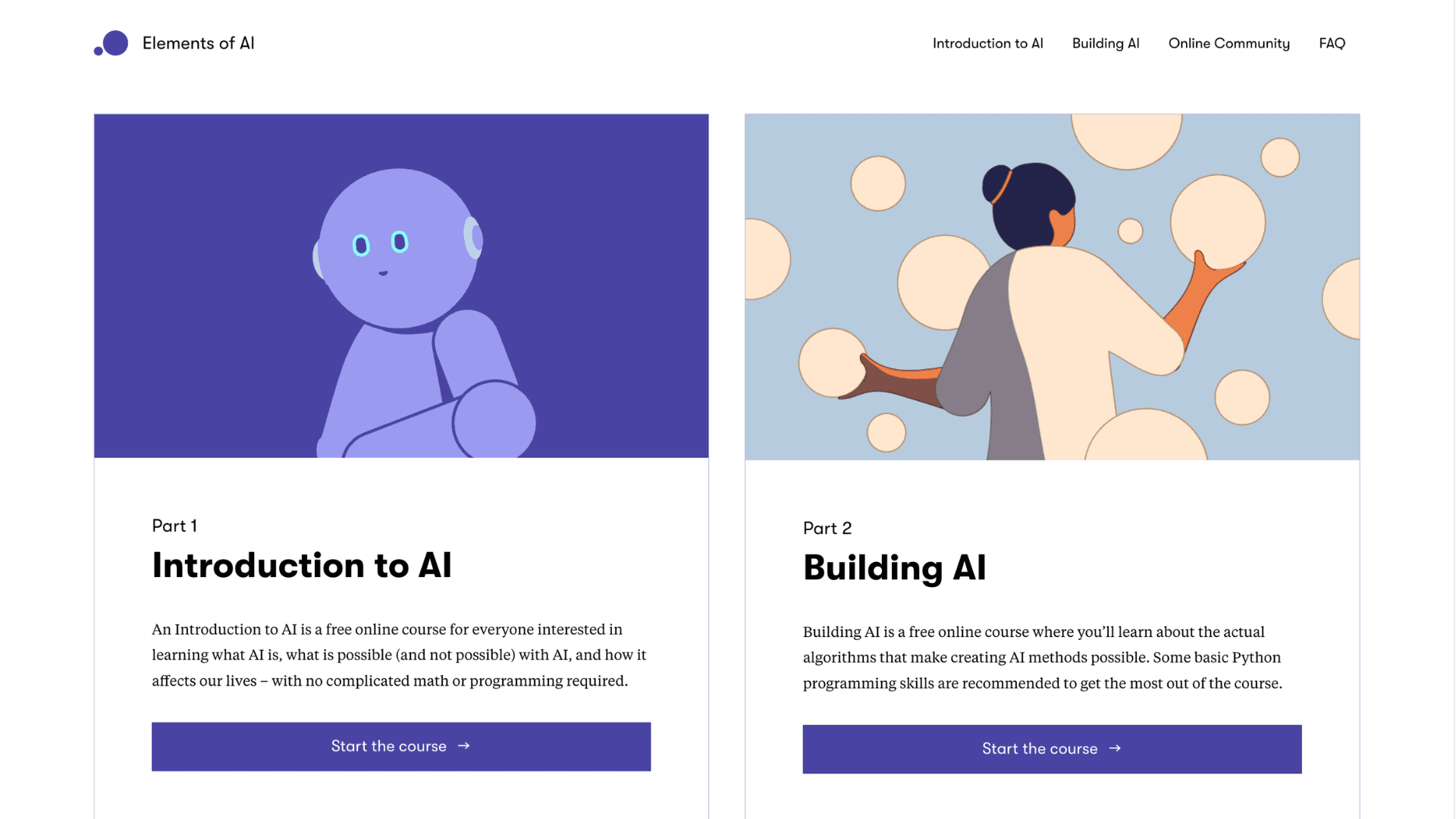
If you’re just starting out with AI, Elements of AI is a non-technical introduction course to check out. It was created by MinnaLearn (an EdTech company) in collaboration with the University of Helsinki, Finland. It combines theory with practical exercises and a flexible learning experience.
The course is divided into two parts: Introduction to AI and Building AI. Introduction to AI covers 6 chapters: What is AI, AI problem solving, Real-world AI, Machine Learning, Neural Networks, and Implications. Building AI includes 5 chapters: Getting started with AI, Dealing with uncertainty, Machine learning, Neural networks, and Conclusions.
By the end of the course, you’ll understand the fundamental concepts of AI, learn how to formulate simple real-world AI problems, and gain a basic understanding of the technical aspects of neural networks. The course also helps learners distinguish between realistic and unrealistic expectations of AI, understand why machine learning techniques are used, and explore the broader societal impact of AI.
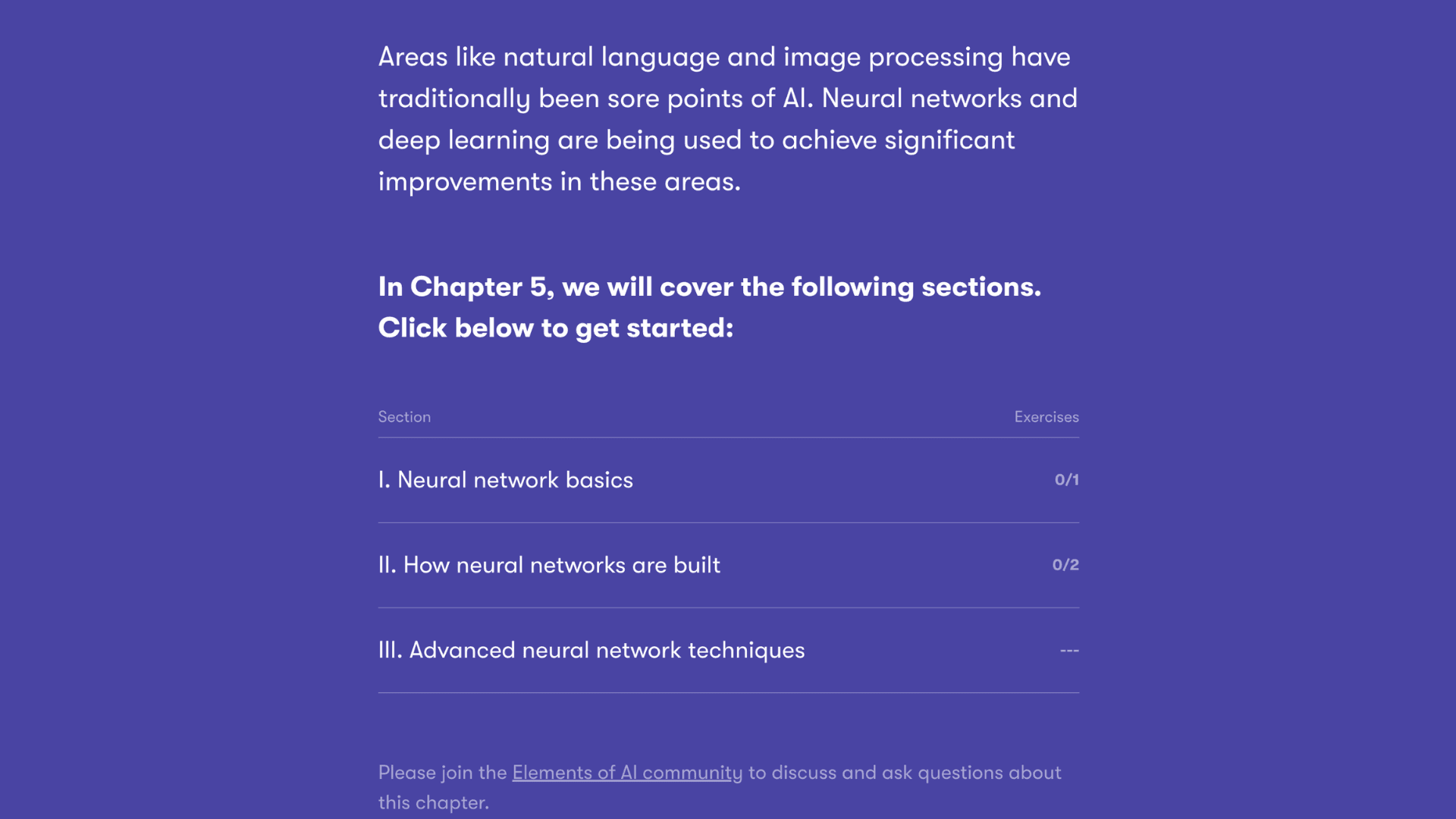
Once you’ve got that down, part 2 takes things further. You’ll learn how AI algorithms work and explore machine learning techniques like linear regression, search problems, Bayesian reasoning, deep learning, etc. For this part, having some basic Python skills will definitely help.
Overall, Elements of AI is an excellent course for beginners. It requires no math or programming knowledge. Unlike many AI courses that focus on how to use ChatGPT, this course provides a whole AI system, like search algorithms, probability, machine learning, and neural networks. Since there are no deadlines, you can complete the course at your own pace.
Keep in Mind
- The materials of each chapter include a long reading; no video content is available
- It covers conceptual basics, not suitable for technical depth
- Doesn’t cover updated AI information like Generative AI, LLMs
2) Google AI Essentials
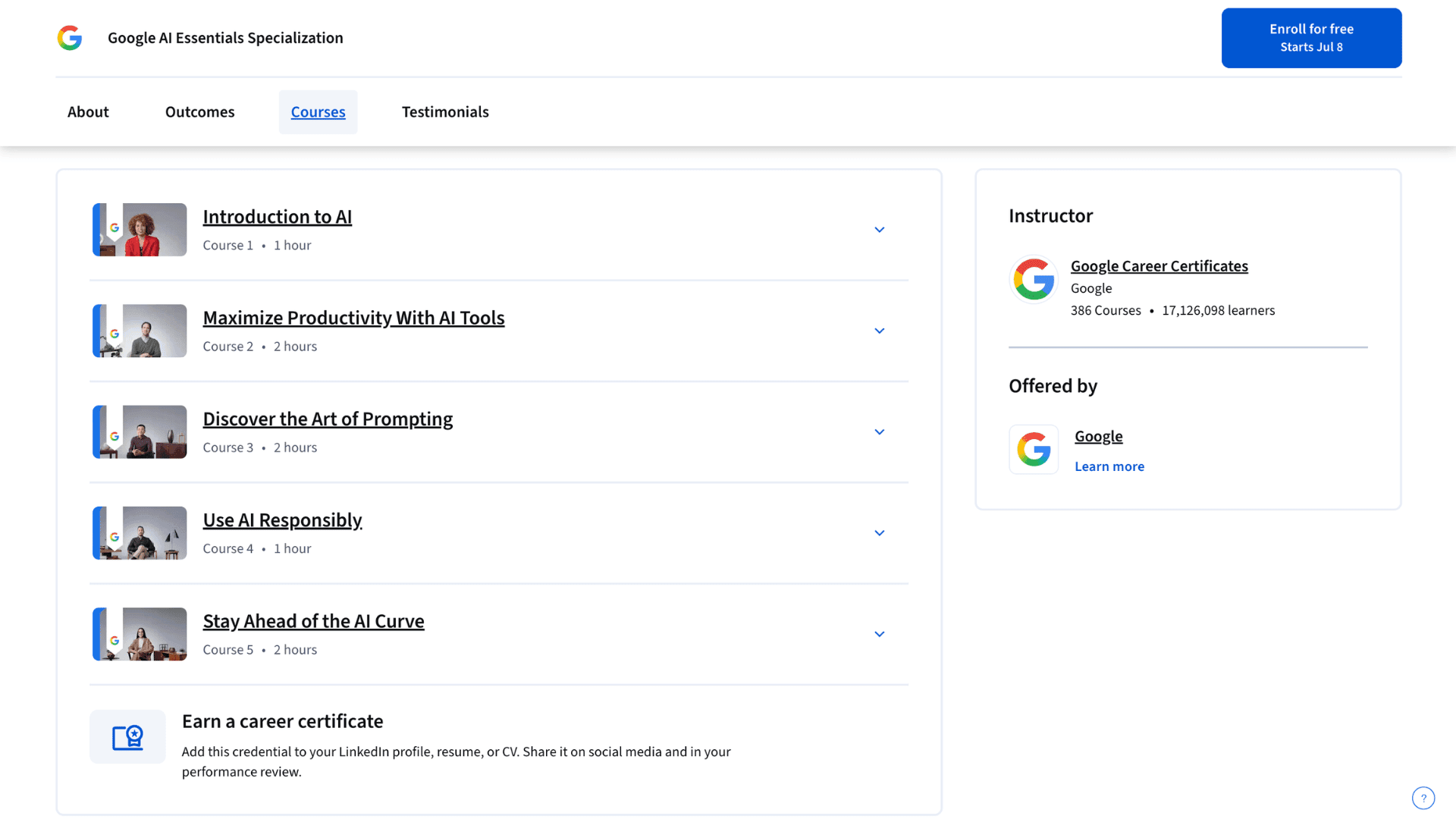
Google AI Essentials is a beginner-friendly course created by AI experts and practitioners at Google. It introduces the foundations of AI and focuses on how to use generative AI tools in everyday work. Unlike Elements of AI, which is focused on AI theory, this course is much more practical. It talks about practical productivity, prompting, responsible use of AI and better decision-making with AI support.
The course is part of Google’s Grow with Google career skills initiative. It’s divided into 5 modules: Introduction to AI, Maximize Productivity With AI Tools, Discover the Art of Prompting, Use AI Responsibly, and Stay Ahead of the AI Curve. Each module includes video, reading, and interactive exercises.
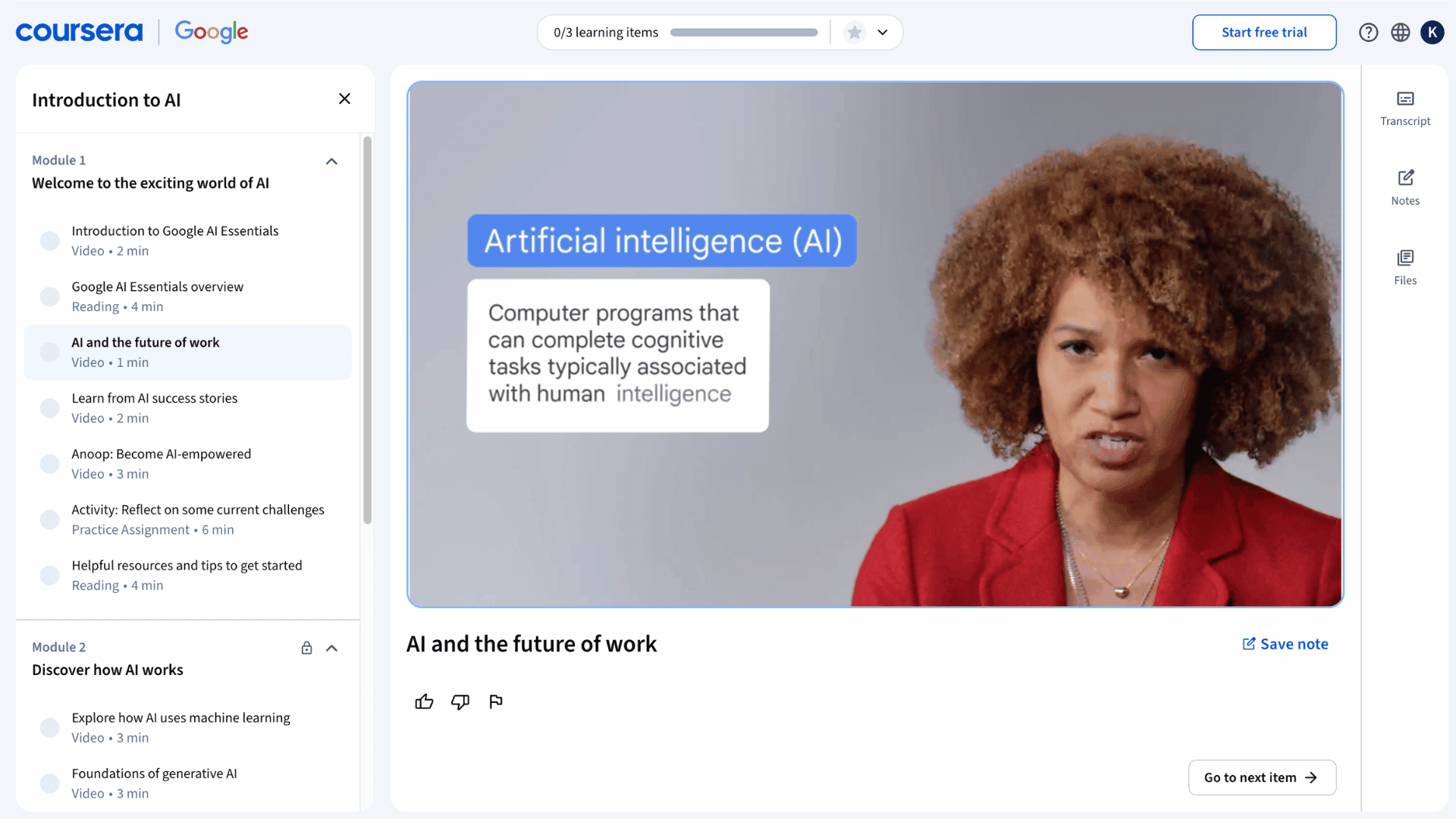
Learners can also participate in hands-on activities based on real-world workspace scenarios. For example, you’ll use AI to brainstorm ideas, create presentation outlines, draft email responses, organize information, and practice writing effective prompts using conversational AI tools like Gemini. The course also discusses the ethical use of AI and, importantly, helps you recognize when AI is and isn’t the right tool for a task.
As a beginner, I’d recommend this course. It won’t teach you how AI works, but it does a good job of providing practical knowledge for day-to-day work. Another bonus is that the course offers a Google-backed certificate to add to a LinkedIn profile.
Keep in Mind
- It’s available only on a 7-day free trial. After that, the course will cost around $49/month.
- The course doesn’t cover deep technical topics, like building AI models, coding machine learning algorithms, or AI engineering.
- You’ll need a paid subscription to earn and access the certificate.
3) CS50x2026 Artificial Intelligence

CS50 is a quite popular entry-level computer science and programming course from Harvard University. You can watch full CS50 course videos for free on YouTube, and the team recently have launched 1 hour lectures on Artificial Intelligence. For someone who wants a deep conceptual understanding of AI rather than just learning how to use AI tools, this lecture is worth watching.
Unlike structured courses with multiple modules, this is a single lecture that includes video lessons and supporting materials. In a 1-hour video, you get knowledge on a wide range of topics, like generative AI, prompt engineering (system prompts vs. user prompts), machine learning fundamentals, decision trees, the Minimax algorithm, neural networks, large language models (LLMs), transformer architecture, and AI hallucinations.
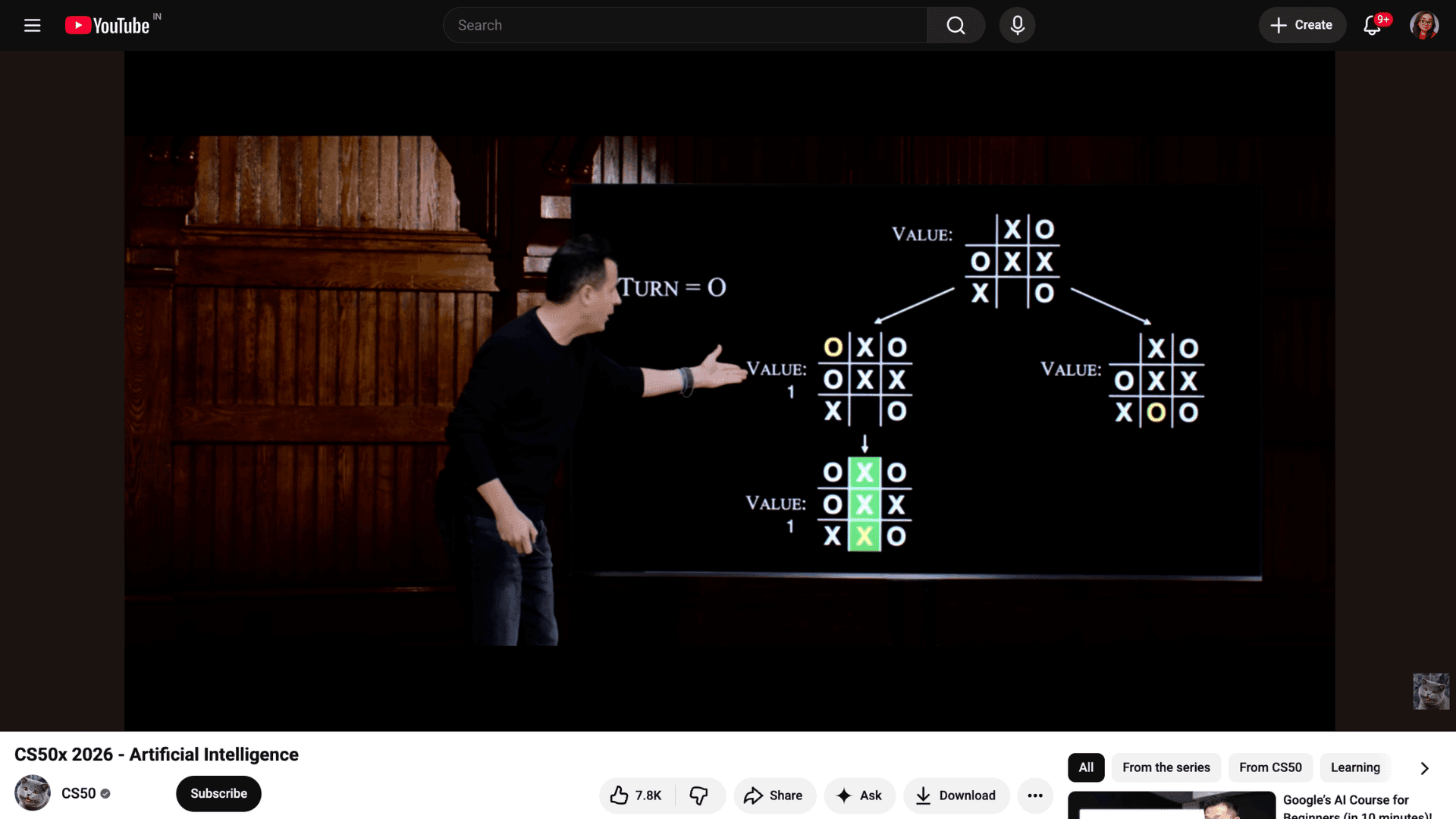
I wouldn’t recommend the CS50x course as your very first AI course unless you’re comfortable with basic computing concepts. The lecture moves at a faster pace and introduces several technical ideas without hands-on practice. However, if you’re willing to engage with more technical concepts or plan to study Python and AI in the future, it’s an excellent next step.
So, first complete any of these courses: Elements of AI or Google AI Essentials, then do this course for a technical step up.
Keep in Mind
- CS50x Artificial Intelligence is a single lecture, not a multi-module AI course.
- It doesn’t include dedicated AI-specific assignments, projects, or hands-on exercises.
- Topics like the Minimax algorithm and transformer architecture can be challenging for complete beginners without a technical background.
- The certificate is available only after the full CS50x course completion
Best Free Prompt Engineering Courses
4) Introduction to Prompt Engineering and Advanced Prompt Engineering
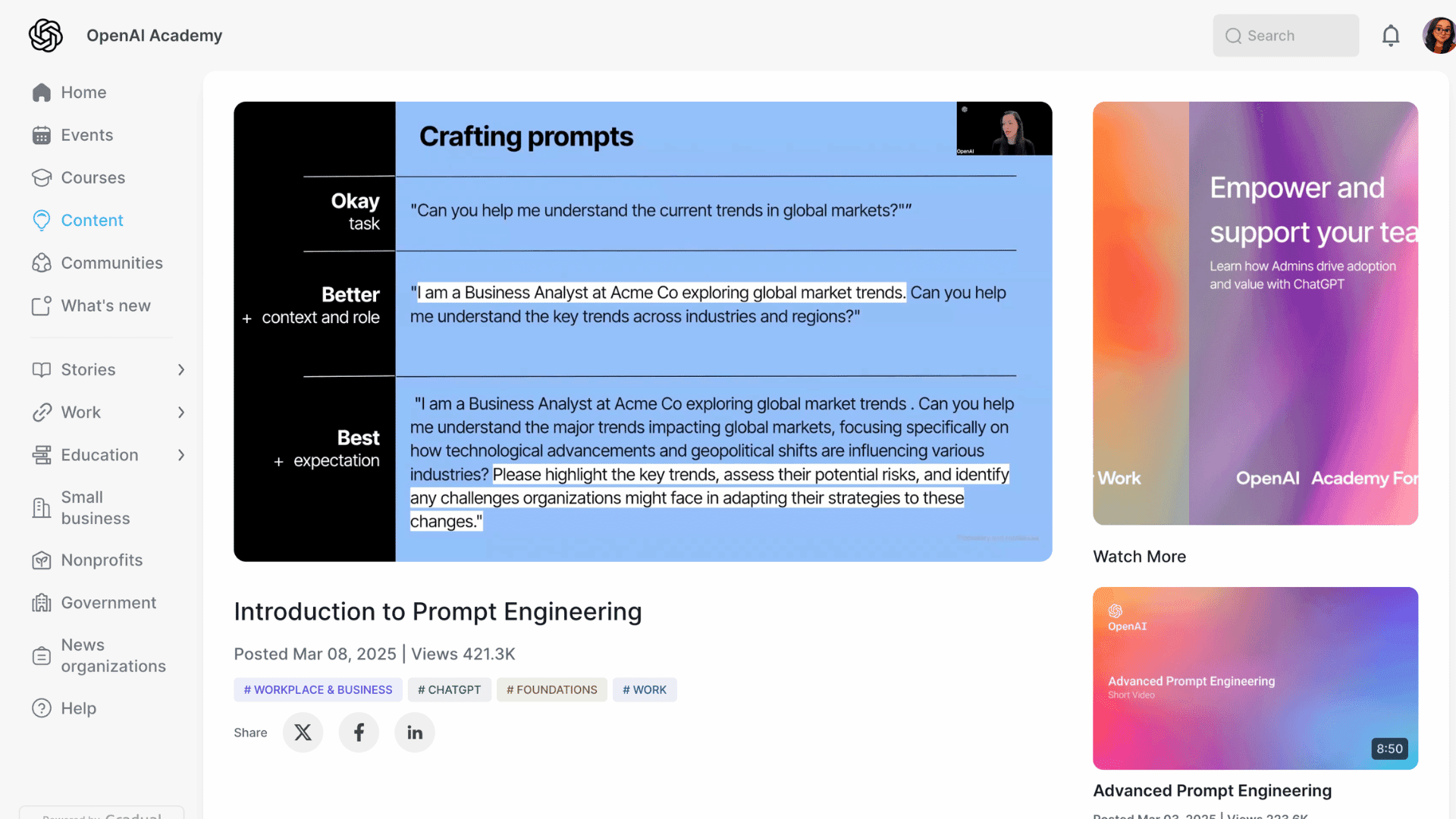
Once you learn the basics, the next skill you should focus on is writing a quality prompt. OpenAI Academy offers two free prompt engineering courses that take you from the fundamentals to more advanced techniques. Introduction to Prompt Engineering teaches how to improve from okay prompts to best prompts. Advanced Prompt Engineering course explores more sophisticated prompting strategies for real-world AI use.
The intro course is a short 5-minute, 52-second video that covers the fundamentals of prompting. It teaches what prompt engineering is, why it matters, and how to write requests to ChatGPT. The documentation also focuses on clear instructions, providing context, structured outputs, and avoiding common beginner mistakes.
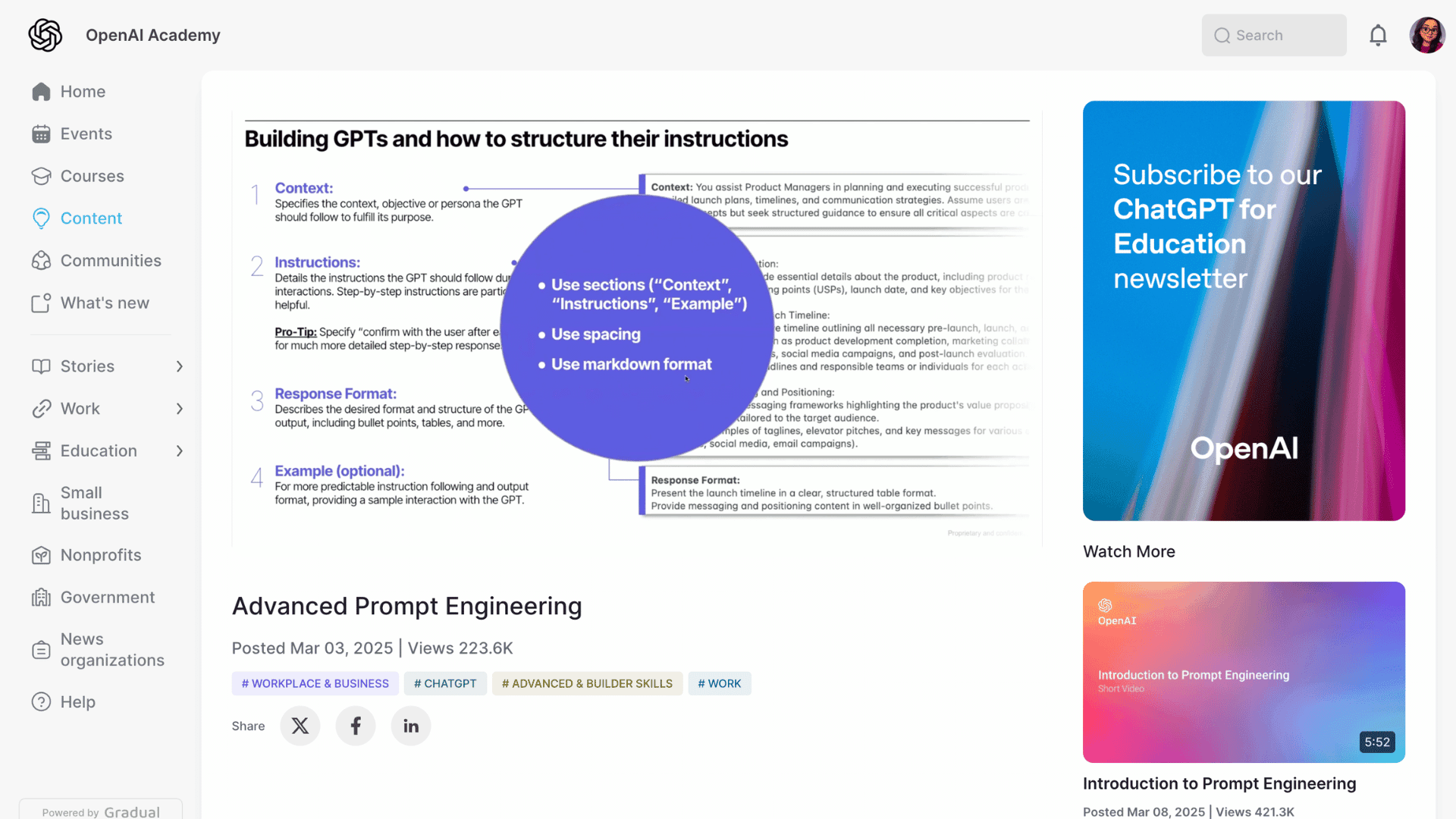
After this, we can move on to the Advanced course. This 9-minute standalone video introduces more mature techniques and system-level thinking. Through practical examples, it explains how to build stronger prompts by defining the right context, assigning roles, setting clear expectations, and refining prompts iteratively. It also covers complex prompt structures and techniques for generating more specialized outputs.
A beginner should definitely invest 15 minutes in these courses. Since they’re created by the company behind ChatGPT, the advice is reliable and directly applicable. The lessons won’t make you an expert overnight, but they’ll help you write prompts that are clearer, more consistent, and easier to reuse across different tasks. And it’ll be easy to follow the next advanced prompt engineering lesson once you have already practiced the basics.
Keep in Mind
- These are standalone video lessons rather than a structured course.
- No certificate is provided upon completion.
- The courses don’t include hands-on exercises.
- You’ll need to sign in with an OpenAI account to access the videos.
5) Prompt Engineering for ChatGPT
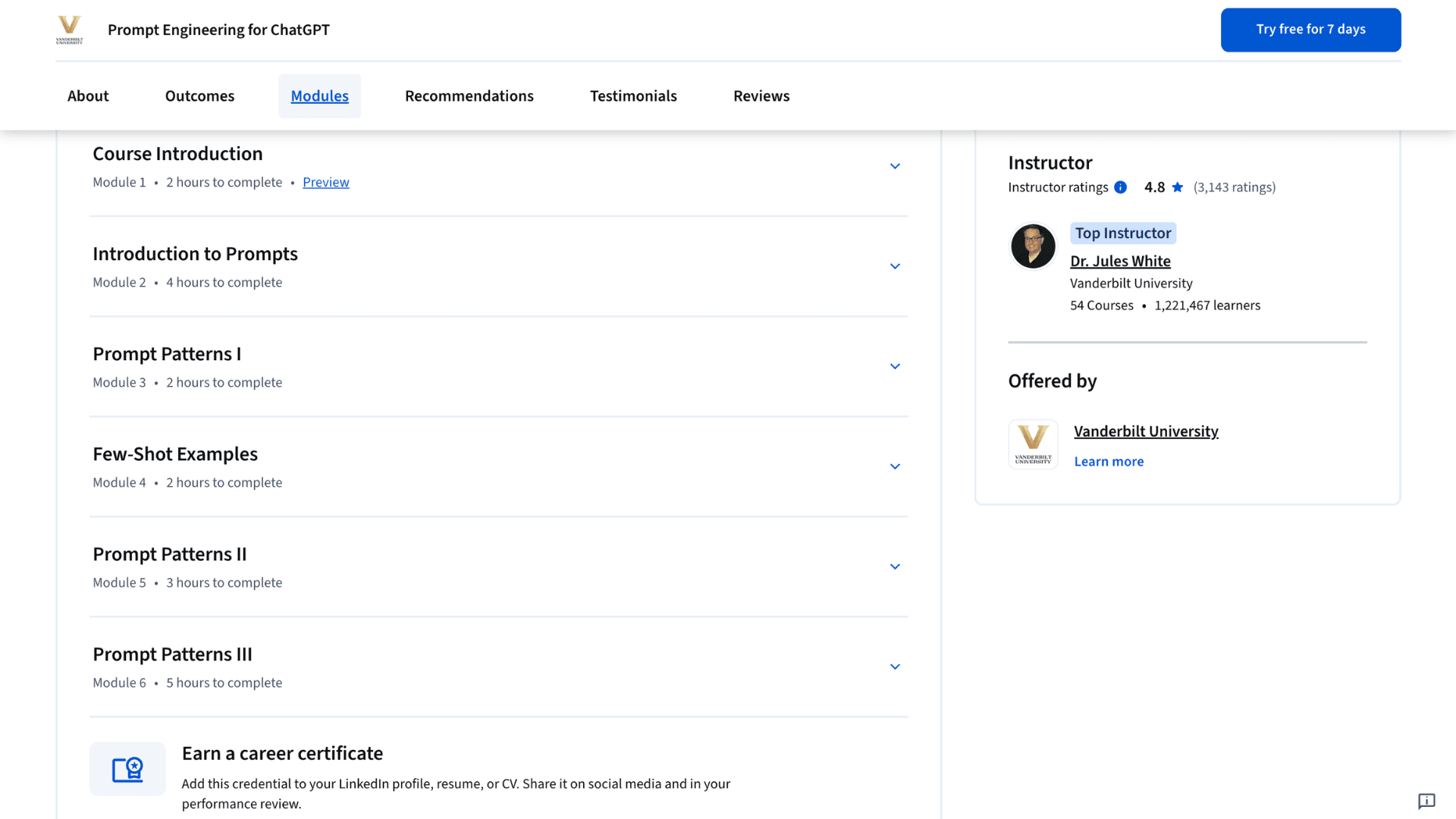
Vanderbilt University offers several AI specialization courses on Coursera, and one of the best options for beginners is Prompt Engineering for ChatGPT. It’s a well-structured, hands-on course that teaches you how to write effective prompts for large language models from the ground up.
The course includes 6 modules. It begins with the basics: what prompts are, how root prompts work, prompt length limits, and more. Next, it focuses on different prompt patterns, with practical examples throughout over three dedicated modules. Each module includes graded assignments. At the end, the learner will have to submit a capstone project, “Creating a Prompt-Based Application,” also.
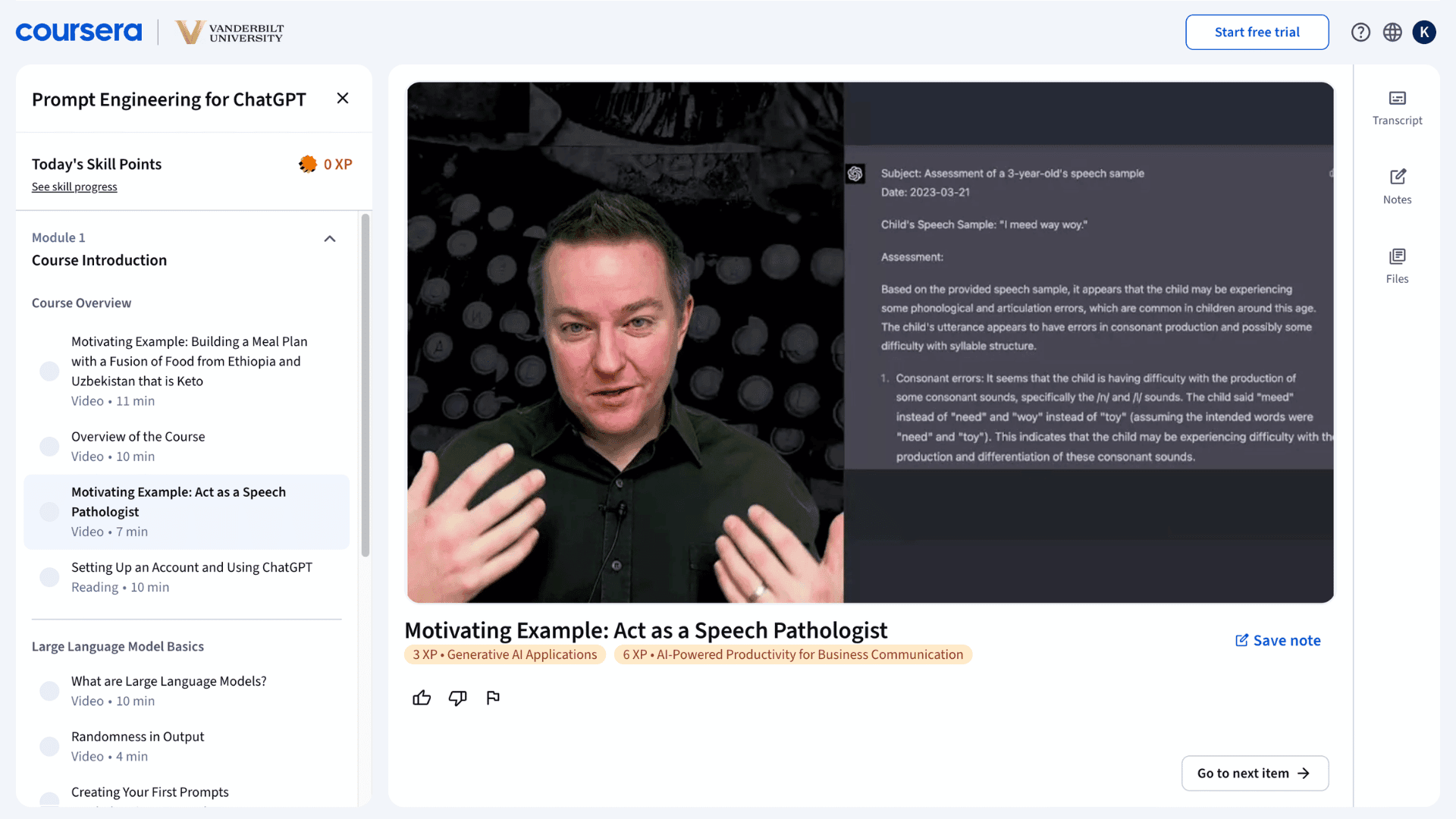
I’d recommend this course to beginners for two main reasons. First, it requires basic computer skills like using a browser and accessing ChatGPT. Another is its practical approach. Instead of only explaining prompts like the OpenAI Academy’s course, this course encourages you to write prompts, test them with ChatGPT, and refine them through guided exercises.
Keep in Mind
- The course is designed for beginners, so it may feel too basic if you’ve already built advanced AI workflows.
- You can take the course for free during Coursera’s 7-day trial, but you’ll need to complete the approximately 20-hour course within that period.
6) ChatGPT Prompt Engineering for Developers
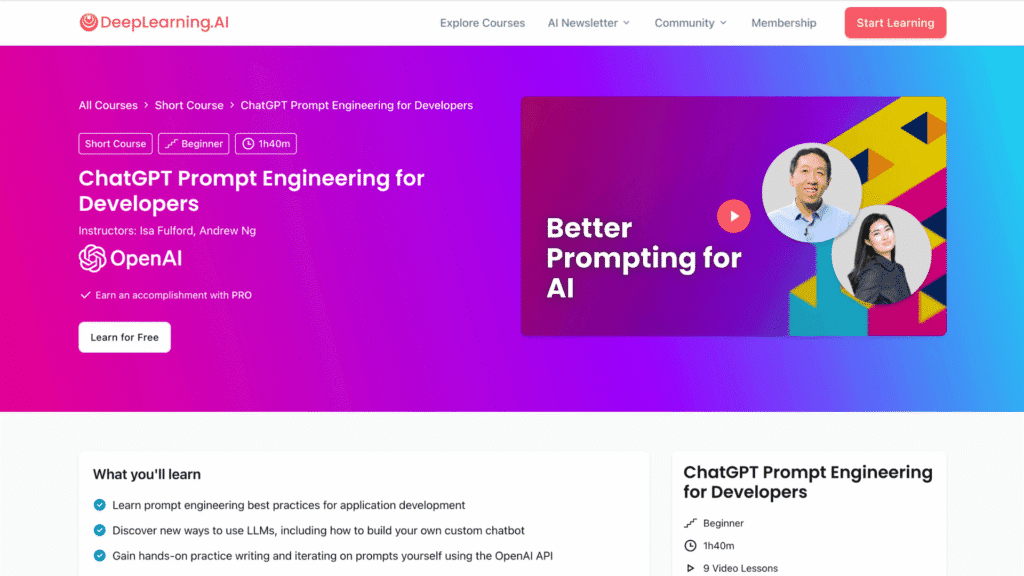
Already have a basic idea of ChatGPT and its use cases? Then you can skip the 1st course and move straight into ChatGPT Prompt Engineering for Developers. It’s a short course developed by DeepLearning.AI in collaboration with OpenAI. The best thing is you’ll learn from two well-known names in AI: Andrew Ng, founder of DeepLearning.AI and co-founder of Google Brain, and Isa Fulford, a member of the technical staff at OpenAI.
The course is divided into 9 video lessons and 7 embedded, runnable Jupyter notebook examples. It starts with the basic concepts of prompt engineering, then moves into real-world use cases like summarizing content, extracting information, repurposing text, and expanding ideas.
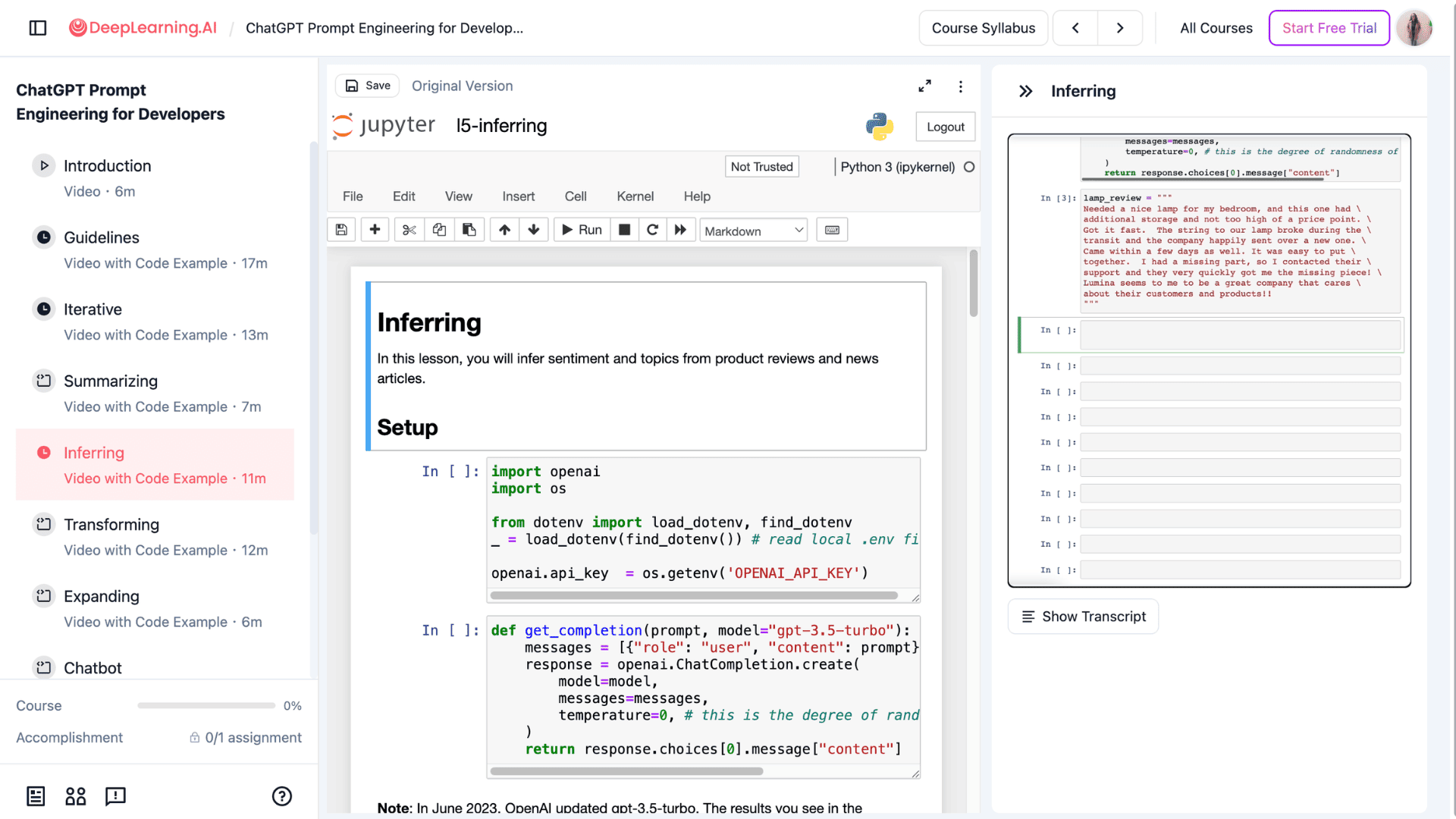
By the end of the course, you’ll be clear about how LLMs respond to instructions and how prompting techniques can be used to build applications such as a custom chatbot. What makes this course particularly useful is the hands-on approach; you’ll write and test prompts using the OpenAI API directly instead of simply chatting with an AI tool.
A beginner should do this course as it’s extremely time-efficient. Within 1.5 hours, the course delivers practical skills. It is especially valuable for people who already know a little Python and want to start working with LLM APIs rather than only using AI through a chatbot interface.
Keep in Mind
- Basic Python knowledge is recommended to follow the course.
- If you’re a complete no-code beginner, the Jupyter Notebook and API-based exercises may feel a little technical.
Best Courses for Generative AI
7) Generative AI for Everyone
Generative AI is a subfield of artificial intelligence focused on creating original, purpose-specific content, like articles, images, music, and code. With tools like Claude, DeepSeek, Midjourney, and Amazon CodeWhisperer, generative AI is now being used across creative and technical workflows. If you’re interested in understanding this broader side of AI, this course is a good place to start.
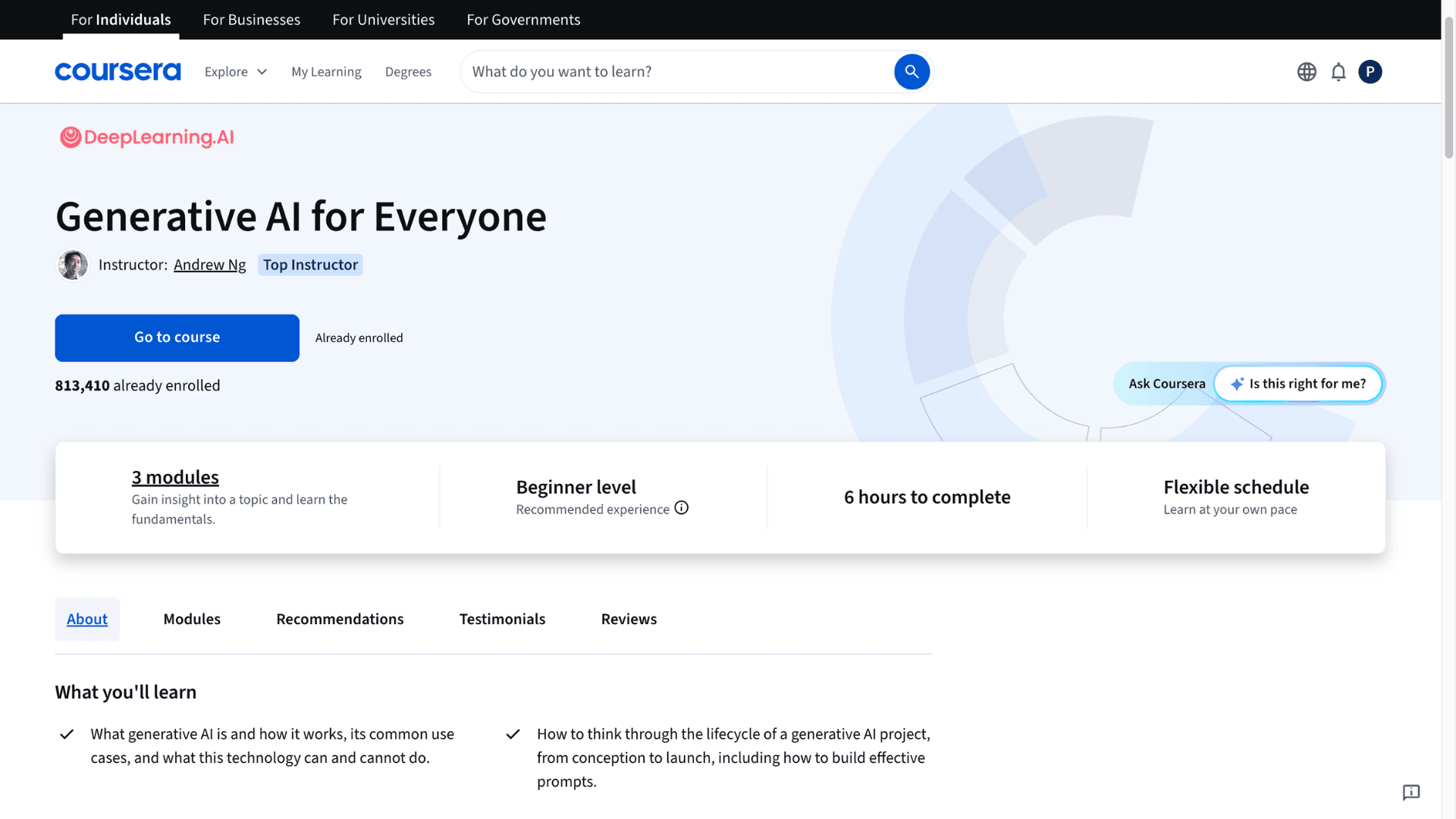
As the name suggests, Generative AI for Everyone helps both individual learners and business professionals. The course is offered by DeepLearning AI and instructed by Andrew Ng, one of the most recognized names in AI education. It’s divided into 3 modules and includes 31 video lessons, reading materials, assignments, and interactive practice activities. The course will take approximately six hours to complete.
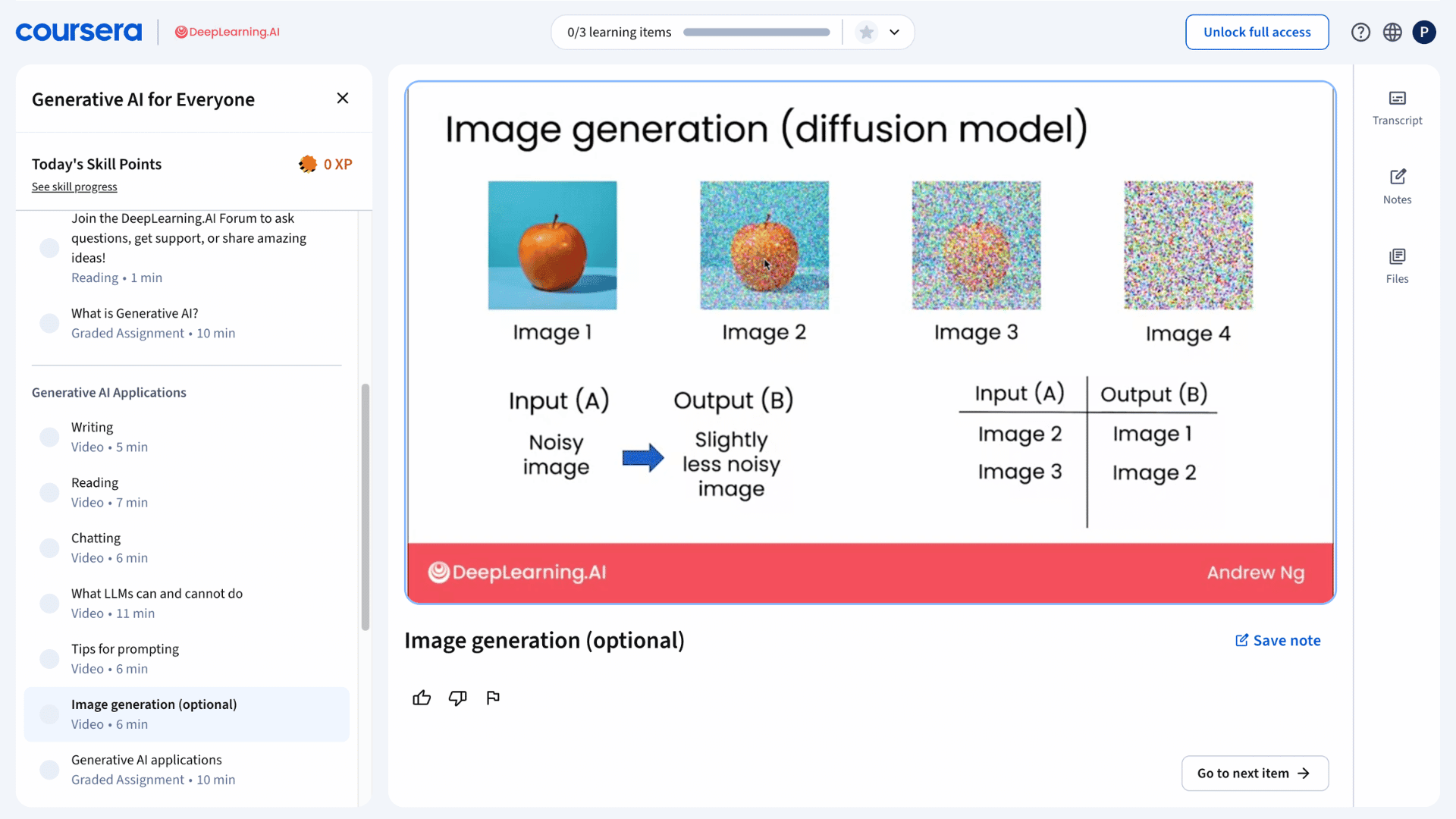
You’ll get a clear overview of how generative AI works, the basic principles behind large language models, and how Gen AI tools can be used in practice. The course also explores real-world generative AI applications, everyday use of web-based LLMs, and the role of generative AI in business and society.
What I particularly like is that, despite being a beginner-level course, it introduces technical concepts such as RAG, fine-tuning, pretraining, instruction tuning, and RLHF at a conceptual level. You won’t learn how to implement these techniques from scratch, but you’ll understand what they mean and where they fit into the broader AI ecosystem.
For beginners, this course provides the vocabulary and conceptual foundation. But they need to follow more advanced AI discussions and technical courses later. The certificate can also be a useful addition to your résumé or LinkedIn profile.
Keep in Mind
- The course certificate isn’t available for free and requires a paid Coursera subscription.
- This is more of a strategic and conceptual course than a hands-on technical course.
- It introduces topics such as LLMs and fine-tuning but doesn’t teach you how to code LLM applications in depth.
Best free LLM and model-building track AI course
8) Hugging Face LLM Course
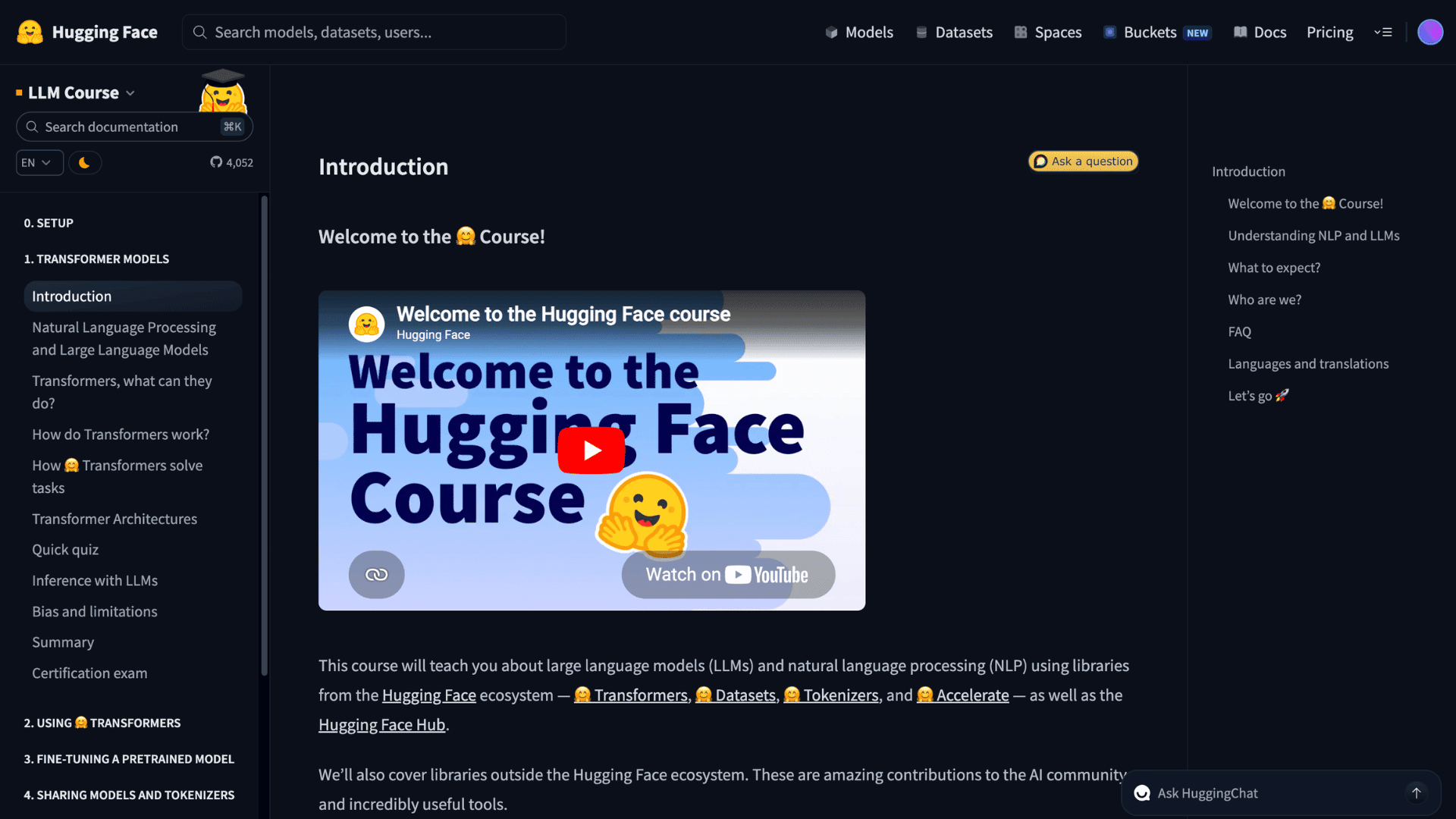
If you’re ready to go beyond basic LLM concepts, the Hugging Face LLM course is an excellent next step. Unlike beginner courses, it will teach you about natural language processing and large language models using the Hugging Face ecosystem (often called “GitHub of AI”). You’ll learn about model workflows, datasets, tokenization, and how to build apps with modern open-source AI tools.
The course includes 12 text-based chapters that include explanations, embedded code examples, and Jupyter notebooks for hands-on practice. Chapter 0 walks you through the environment setup. In the first chapter, we’ll be introduced to the fundamentals of transformer architecture. From there, the course moves into model-centric learning, NLP tasks, fine-tuning large language models, reasoning models, and other practical topics. It concludes with a quiz to help you assess your understanding.
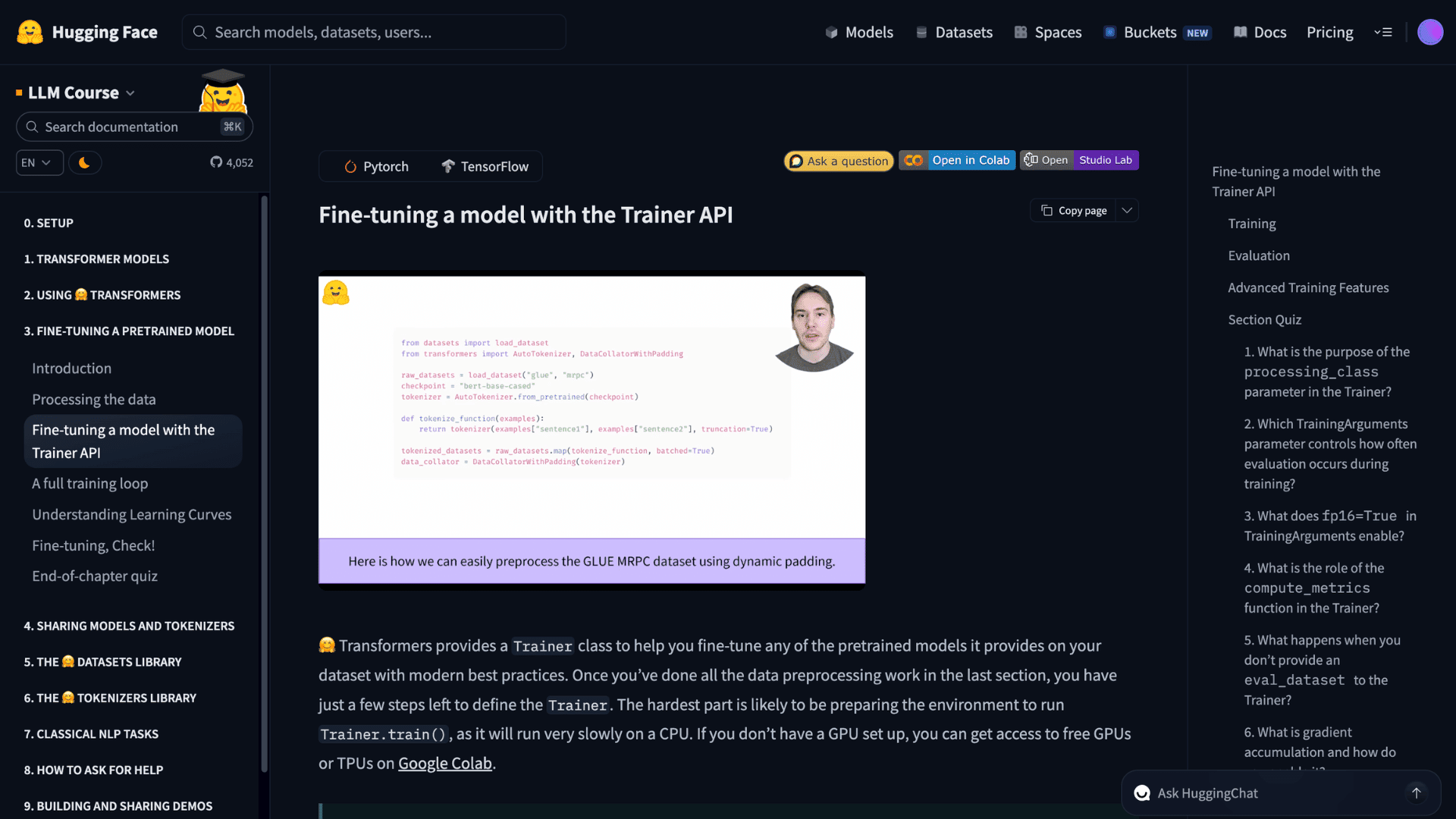
After completing this course, you’ll know how to work with datasets, build and share model demos, and gain practical experience using Hugging Face pipelines. One of the advantages is that it combines theory with hands-on coding. It teaches actual LLM engineering, rather than just prompt writing.
I wouldn’t recommend this as your first LLM course if you have little or no programming experience. If you already understand the basics of AI and are familiar with Python, it’s one of the best free resources for moving from AI user to AI builder.
Keep in Mind
- This is a technical course and assumes you’re comfortable working with code and AI development tools.
- A basic knowledge of Python is required.
- Since the course is open-source and completely self-paced, it requires self-discipline.
- No certificate or formal credential is provided upon completion.
9) LLM course by Andrej Karpathy
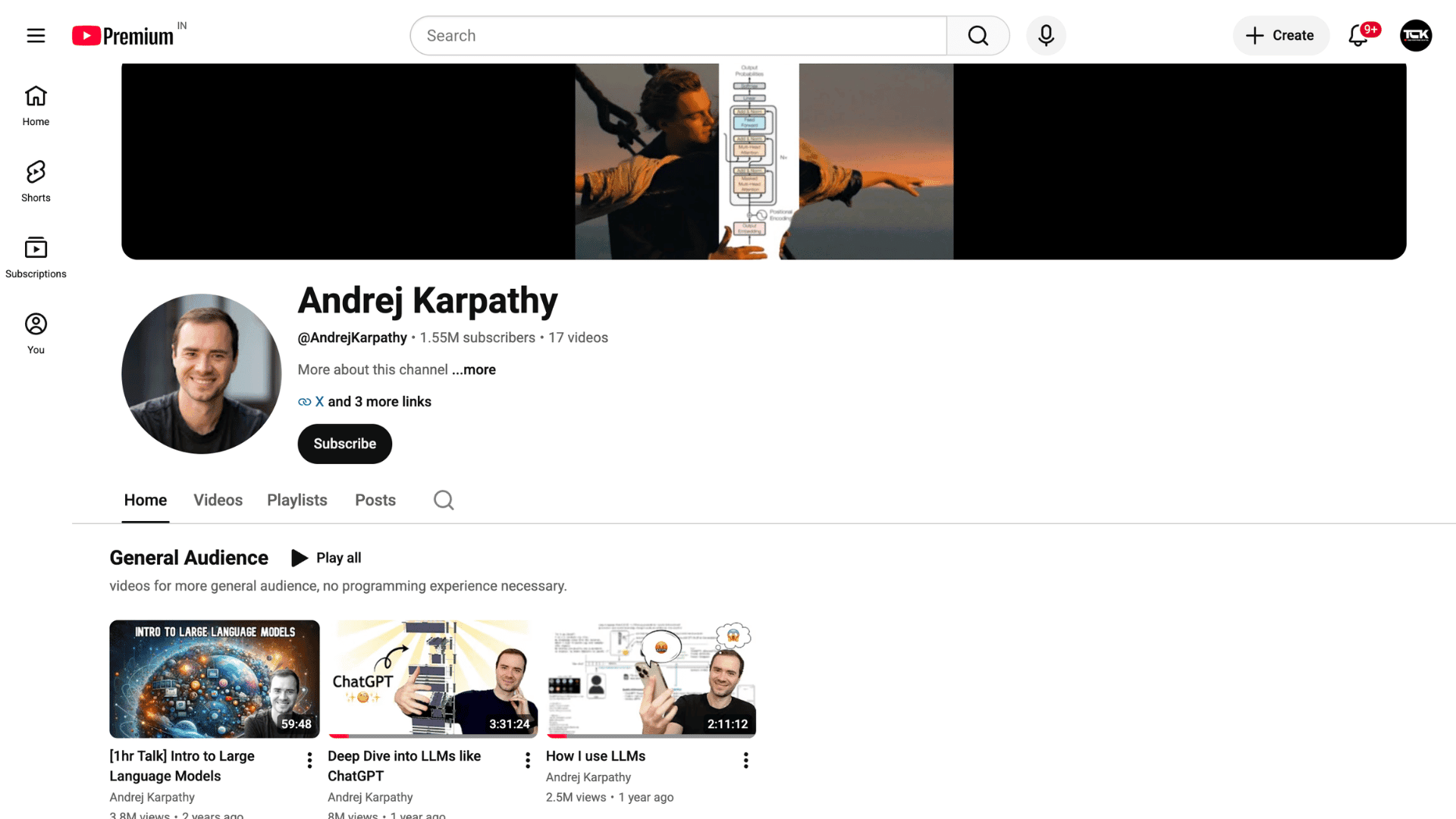
Andrej Karpathy is a former Director of AI at Tesla, a founding member of OpenAI, and the most respected AI educator today. His LLM learning video is one of the best free resources if you want to understand how GPT-style models work. He’s well known for his Neural Networks: Zero to Hero series and his Deep Dive into LLMs lectures. But if you don’t have time for a full technical course and want a practical masterclass instead, How I Use LLMs is the video I’d recommend.
This single 2-hour video provides well structured with clearly segmented lessons. It covers the LLM ecosystem, how ChatGPT works, effective LLM interaction patterns, choosing the right model for different tasks, reasoning (“thinking”) models, and deep research workflows.
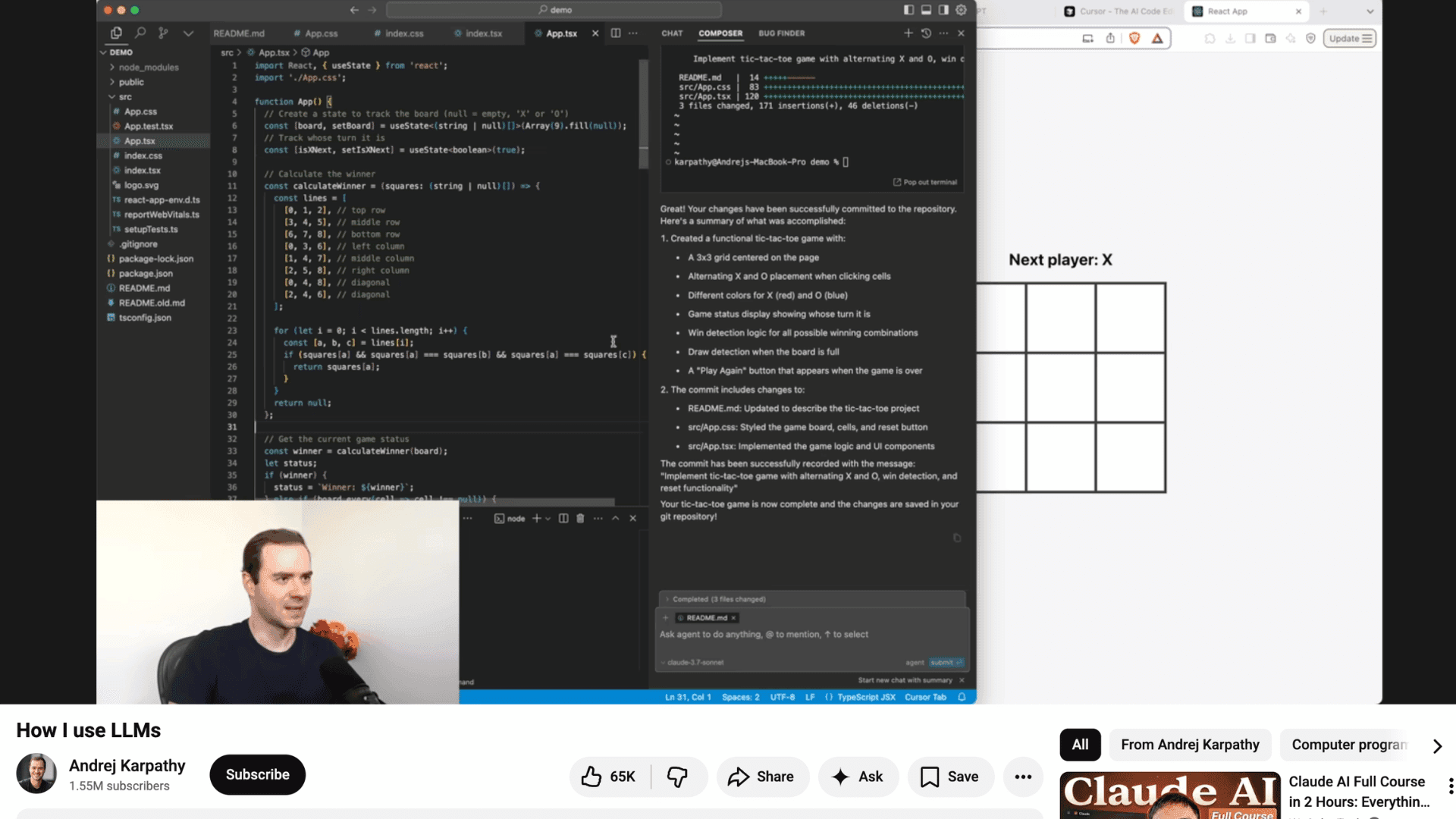
You get the knowledge of today’s most useful AI tools and features, like Python interpreter, advanced data analysis with ChatGPT, Claude Artifacts, Cursor, NotebookLM, custom GPTs, multimodal capabilities, memory, and custom instructions. Rather than teaching coding, it focuses on how to use these tools effectively to solve real-world problems and get better results from LLMs.
If you’re serious about using AI in 2026, I think this video is well worth the time. It won’t teach you how to build an LLM from scratch, but it does provide a practical when to use different tools. And if you’re already using these models, the lessons will also help you avoid using the wrong tool for the wrong job.
Keep in Mind
- This isn’t a structured beginner course and doesn’t teach AI fundamentals.
- The video covers many AI tools and concepts, which may feel overwhelming if you’re completely new to AI.
- The lesson is two hours long, so need significant time commitment
10) Claude Code in Action
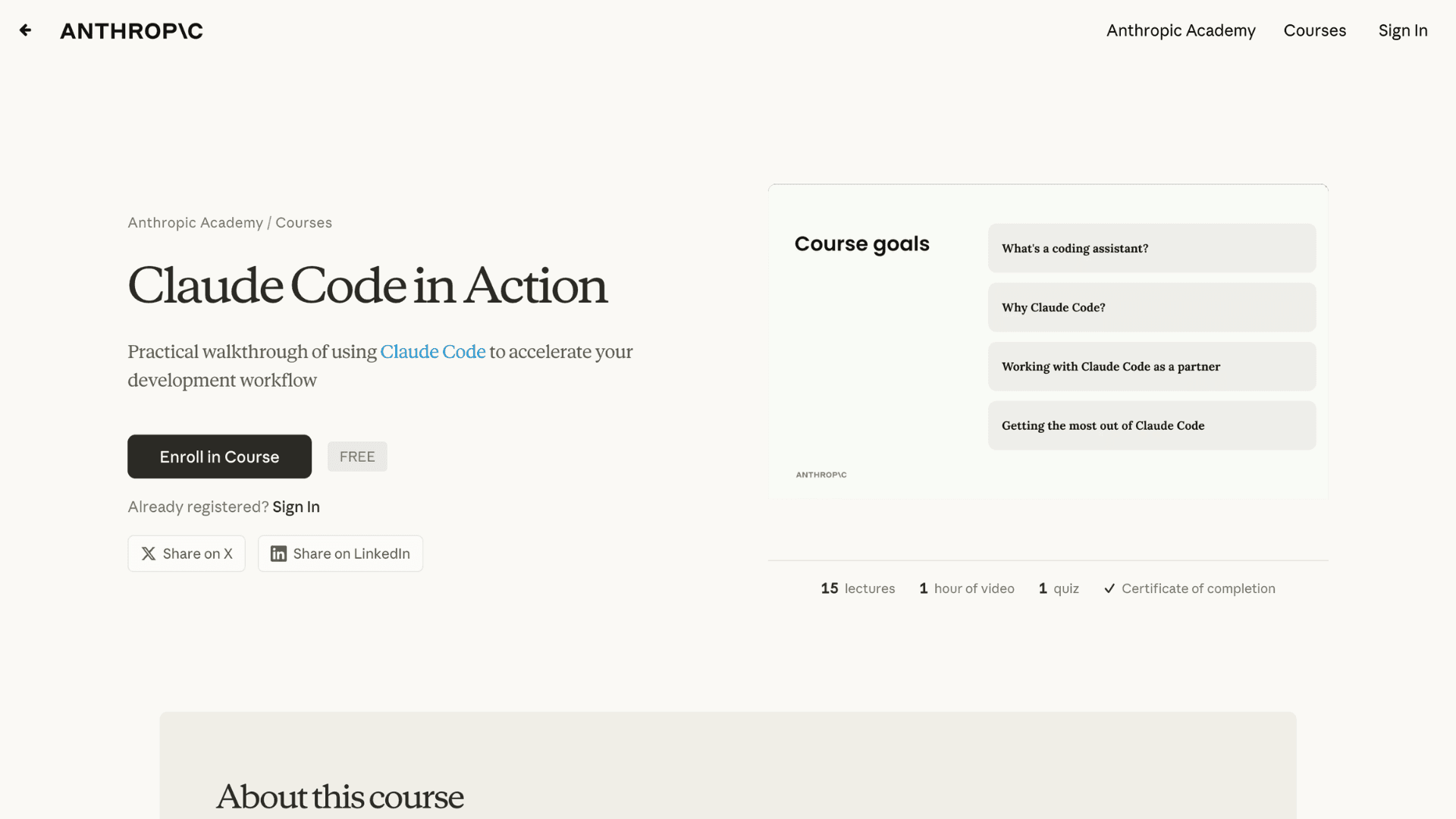
Anthropic Academy offers some amazing courses on AI through its learning management system, Skilljar. Claude Code in Action is the course that I’d recommend if you are interested in using Claude Code for software development tasks. The course focuses on real development workflows, not just theory. So learners get a practical look at how an AI coding assistant can fit into day-to-day software engineering.
Claude Code in Action complete course includes 15 video lectures, hands-on exercises, and quizzes. It starts with an introduction to Claude Code and guides you through setup and practical project work. The modules cover topics such as project setup, custom commands, MCP servers, GitHub integration, hooks, and the Claude Code SDK. The course concludes with a quiz to test your understanding of Claude Code.
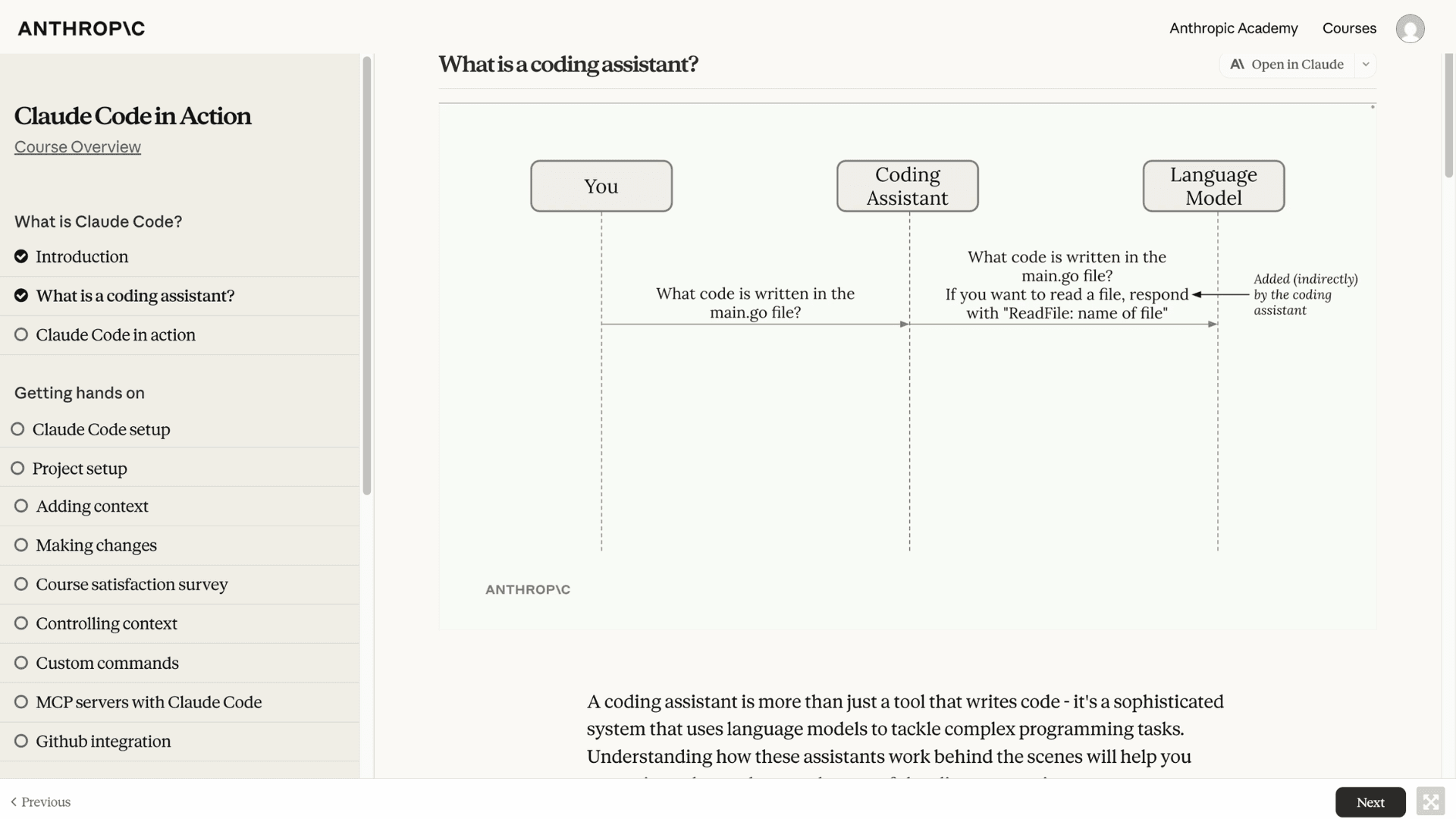
Upon completion, you’ll have a solid knowledge of coding assistant architecture, how to use Claude Code effectively on a project, and how to manage context for better results. You’ll also learn how to create custom commands, extend Claude Code’s functionality with MCP servers, integrate it into GitHub workflows, and use hooks and the SDK for automation.
If you are a developer, you don’t want to miss this opportunity to learn directly from Anthropic. The course doesn’t just mean watching videos but also includes actual setup, project work and real tooling. Remember, you must have basic familiarity with command-line interfaces (CLI) and version control with Git.
Keep in Mind
- Since the course requires familiarity with Git and the CLI, it’s not suitable for non-coders.
- The course focuses on using Claude Code rather than teaching model building or the technical foundations of LLMs.
Best free AI agents and workflows courses
11) Hugging Face Agent Course
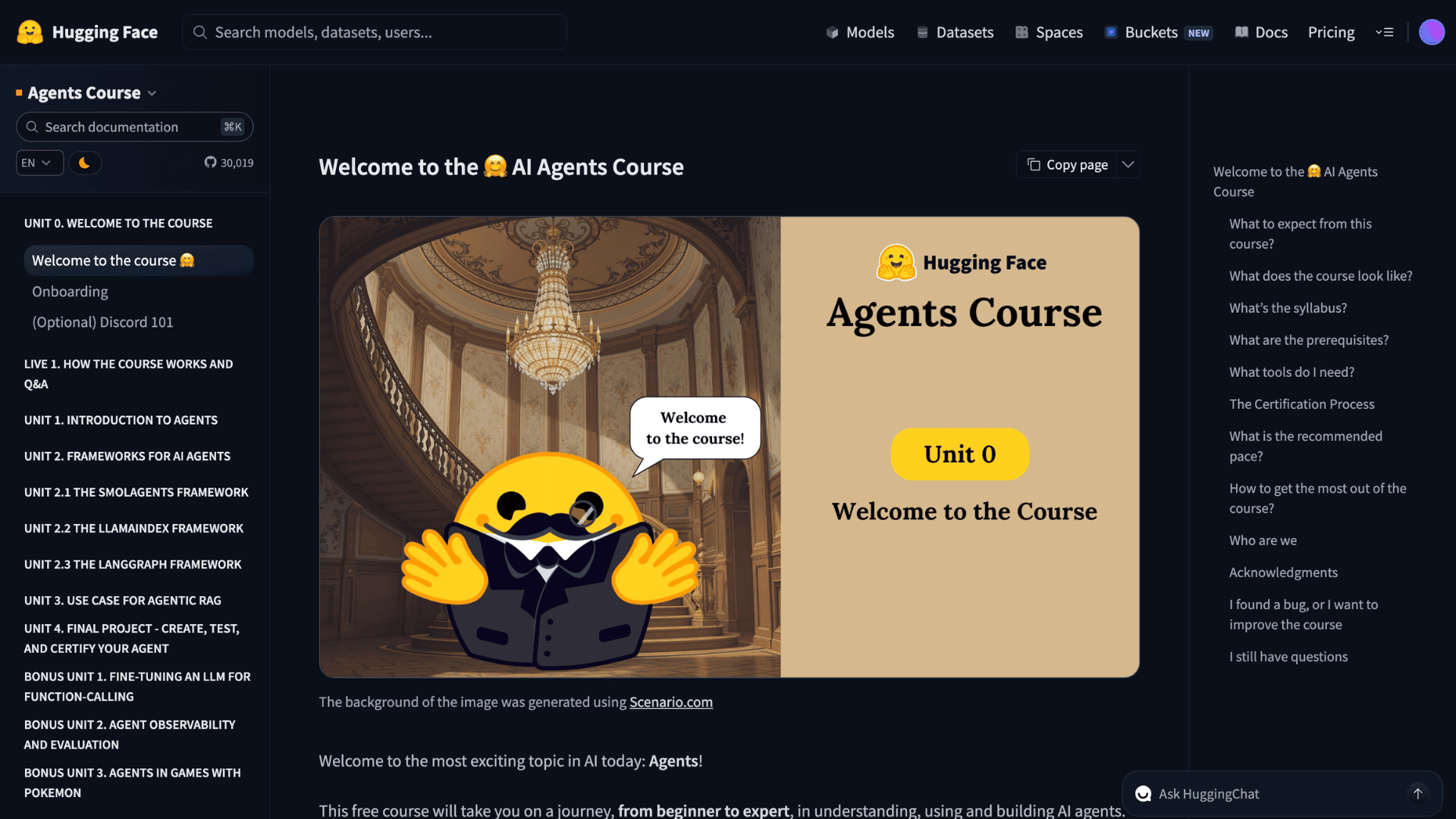
The Hugging Face AI Agents Course is a free, certified course that evolves learners from beginners to experts in building AI agents. This course is like “a living project” with community feedback and contributions through GitHub. It combines theory, exercises using Hugging Face Spaces, real use cases, and competitive challenges.
There are a total of 5 main units and 3 bonus units. Each chapter will take approx 3-4 hours per week to complete. It starts with the core concepts behind AI agents and gradually moves into agent frameworks, practical use cases, and a final assignment where you’ll build your own AI agent.
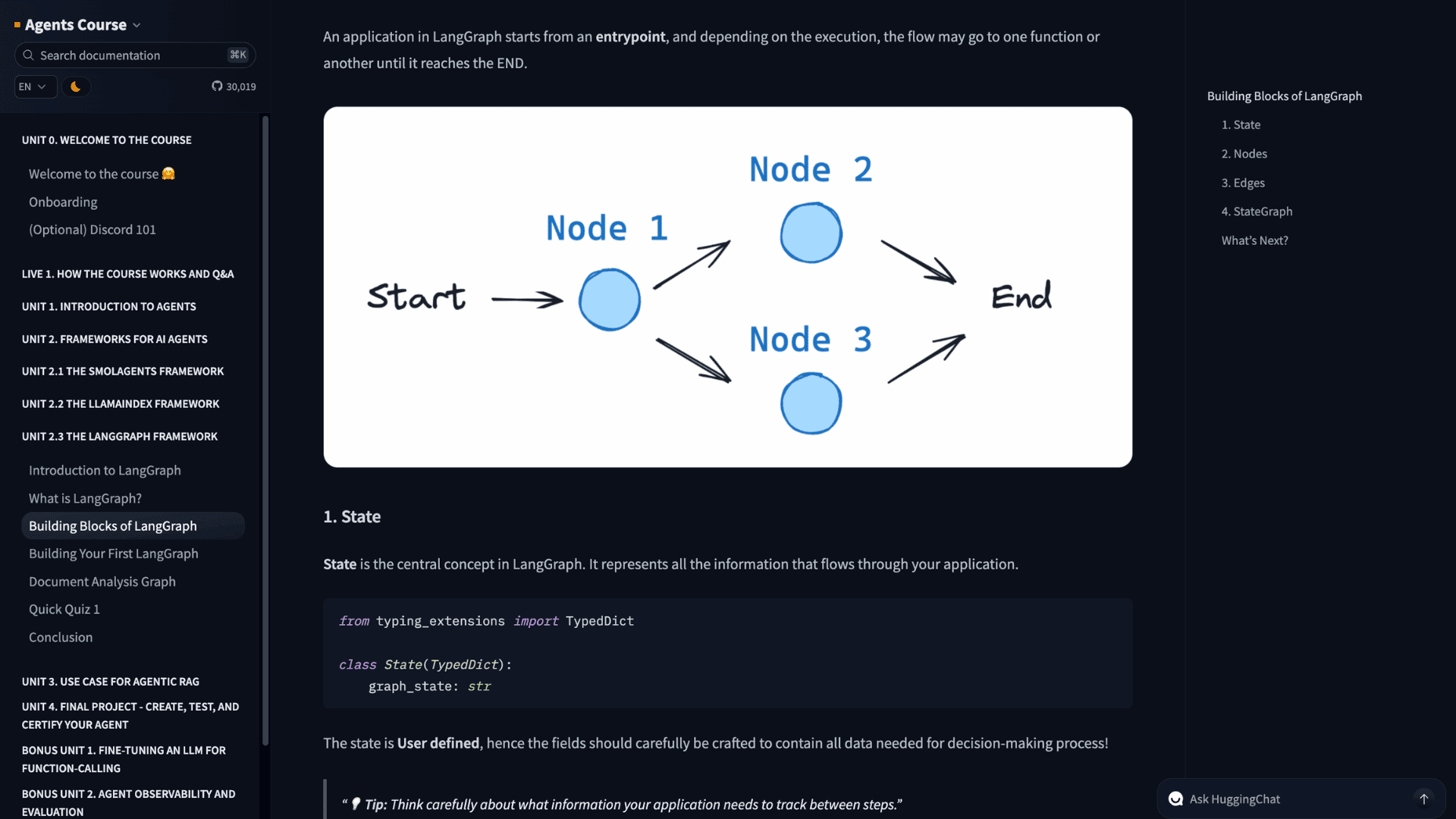
Throughout this course, you’ll first develop a theoretical knowledge of how AI agents work. Gradually, we’ll get hands-on experience with popular agent libraries and frameworks such as smolagents, LlamaIndex, and LangGraph. The ultimate goal is to build and test your own agent while understanding the workflows behind real-world agent systems.
I really liked this course because it uses pre-configured Hugging Face Spaces, so you can practice without complicated local setup. It includes a leaderboard challenge that provides real competitive elements. For learners who want to move beyond basic chatbots and learn how to build AI systems that can search, call tools, and complete multi-step tasks, this course is a strong entry point
Keep in Mind
- Basic Python knowledge is required
- Since there are no fixed deadlines, you’ll need to stay disciplined and accountable to complete the course at your own pace.
12) Build & Sell n8n AI Agents
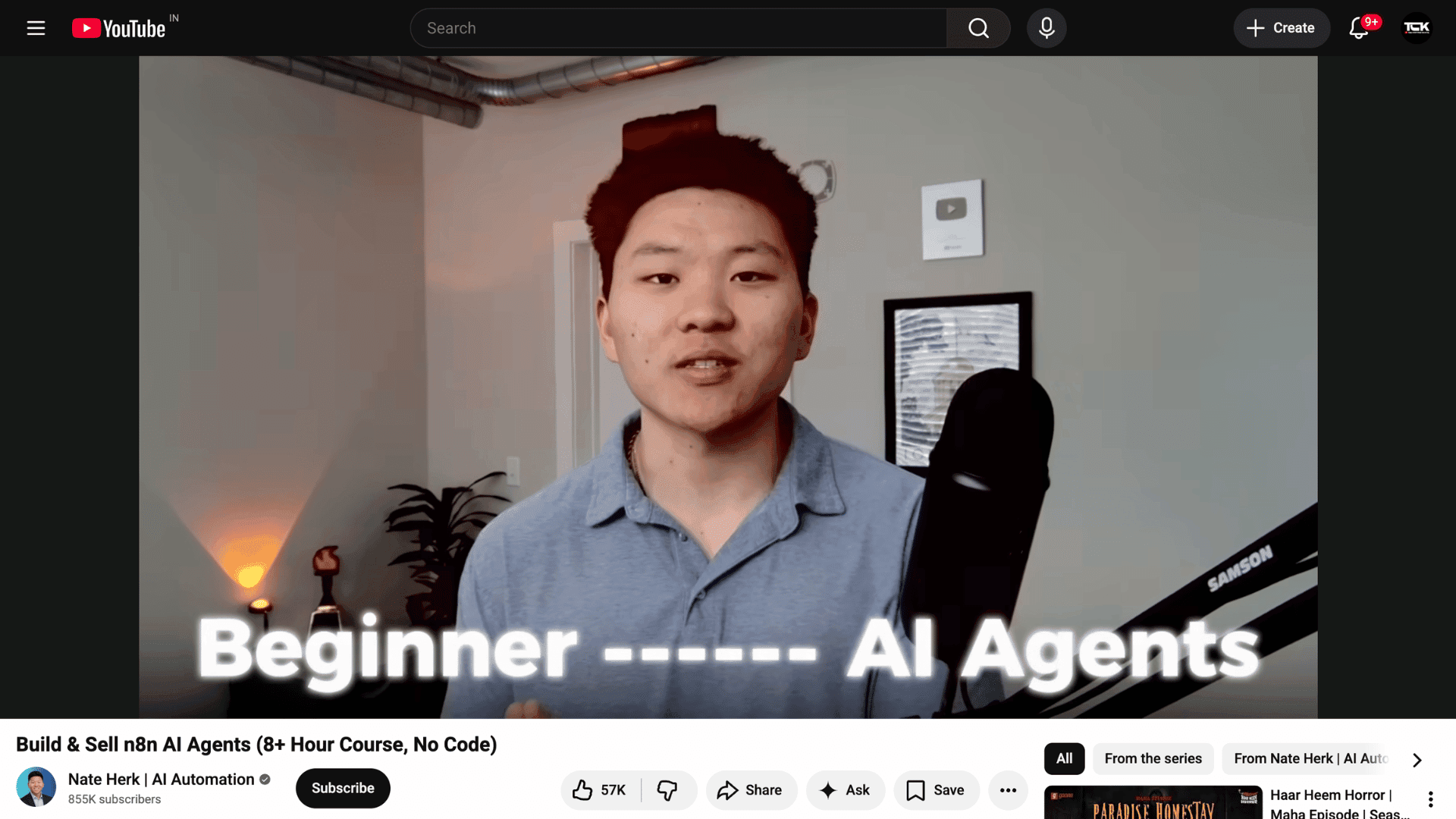
If you’re an absolute beginner with no coding knowledge, you can still learn how to build AI agents. Build & Sell n8n AI Agents is one of the most practical free resources I’ve found for learning how to create no-code AI agents and automation systems with n8n. Unlike the structured modules of the Hugging Face course, this is a single 8+ hour YouTube video that you can watch for free.
The entire video is timestamped into chapters for easy navigation. It starts by explaining AI automation and then introduces the core n8n building blocks, system design, and agentic workflows. As you progress, you’ll learn how to set up common API and HTTP requests, design systems with multiple cooperating agents, follow live prompting examples, and set up self-hosted n8n connected to MCP servers, etc.
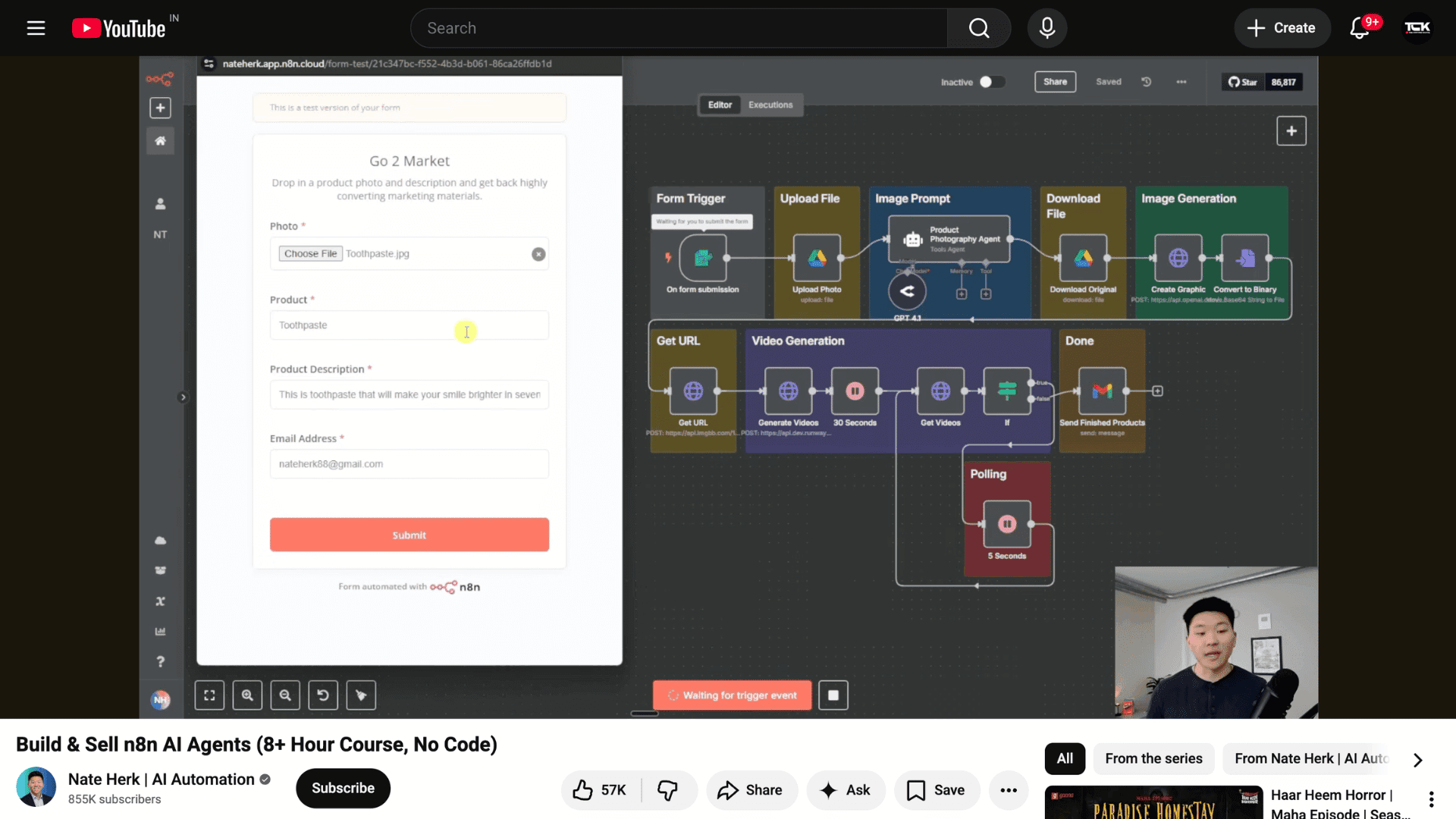
AI agents and automation are among the most valuable practical AI skills to learn in 2026. What makes this course stand out is its focus on practical implementation. The course includes detailed 15+ real automation builds. Hence, a beginner should take this course if they want a fast, practical way to build useful, sellable automation systems rather than focusing on academic AI theory.
Keep in Mind
- Unlike courses from Google, Harvard, or Hugging Face, this course isn’t backed by a major AI organization.
- It’s designed purely for practical skill-building, and no formal certificate or credential is provided.
- The course focuses heavily on building workflows with n8n rather than teaching the deeper technical foundations of AI agent frameworks.
Best free AI courses for Vibe Coding
13) Vibe Coding 101 with Replit
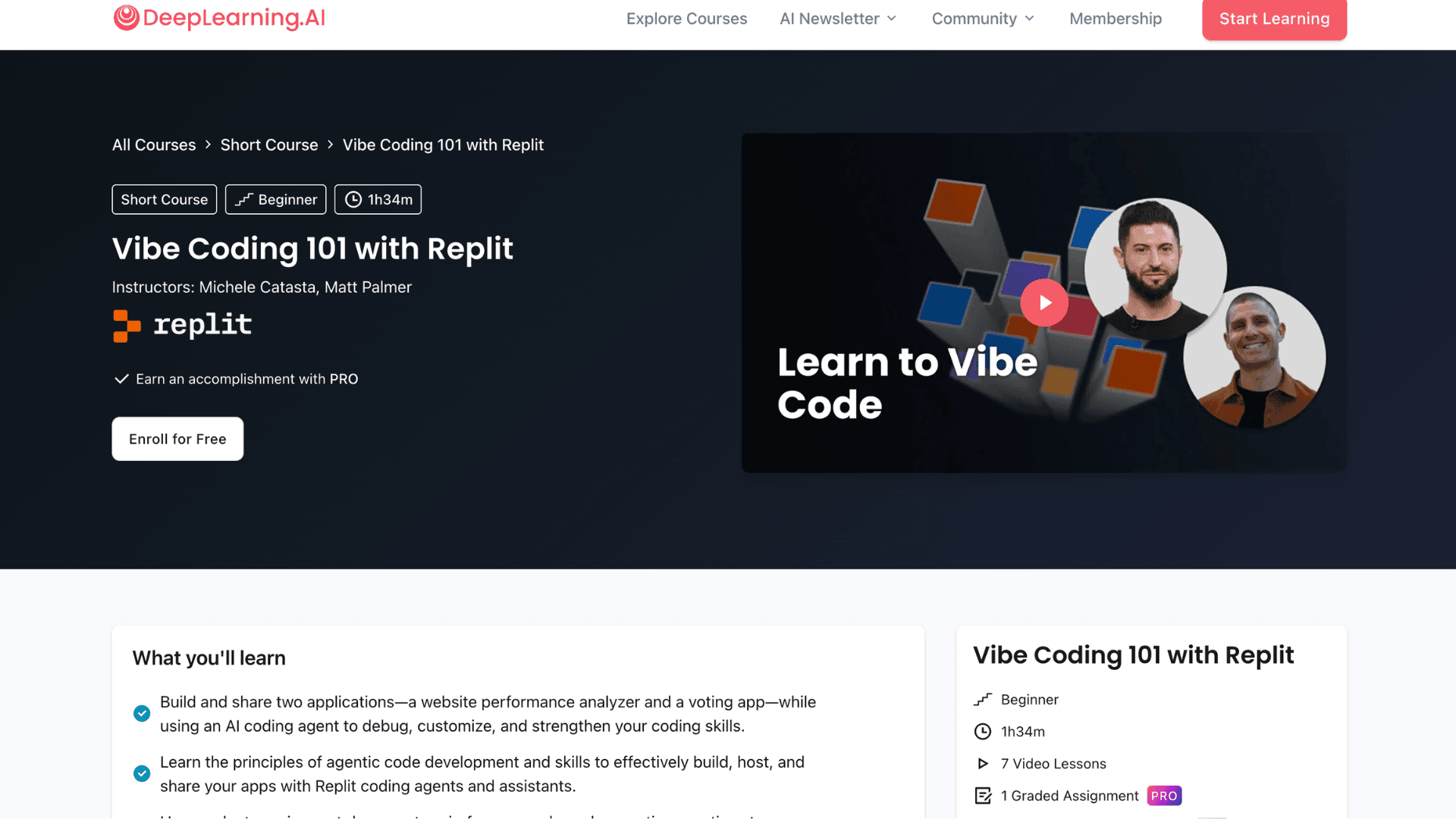
Someone who doesn’t have coding knowledge: Vibe coding is a useful skill to learn. It allows you to build software by describing what you want in natural language. Vibe Coding 101 with Replit, developed by DeepLearning.AI in collaboration with Replit, is a beginner-friendly course designed to help you build this skill. It teaches learners how to build web apps with an AI coding agent directly in Replit’s cloud environment.
The course includes 7 video lessons and 1 graded quiz. The module covers principles of agentic code development, creating a Product Requirements Document (PRD) and wireframe, building a website performance analyzer prototype, using Replit’s AI assistant effectively, and building and deploying apps directly from the browser. You’ll also learn how to debug issues, iterate on your projects, and share your work.
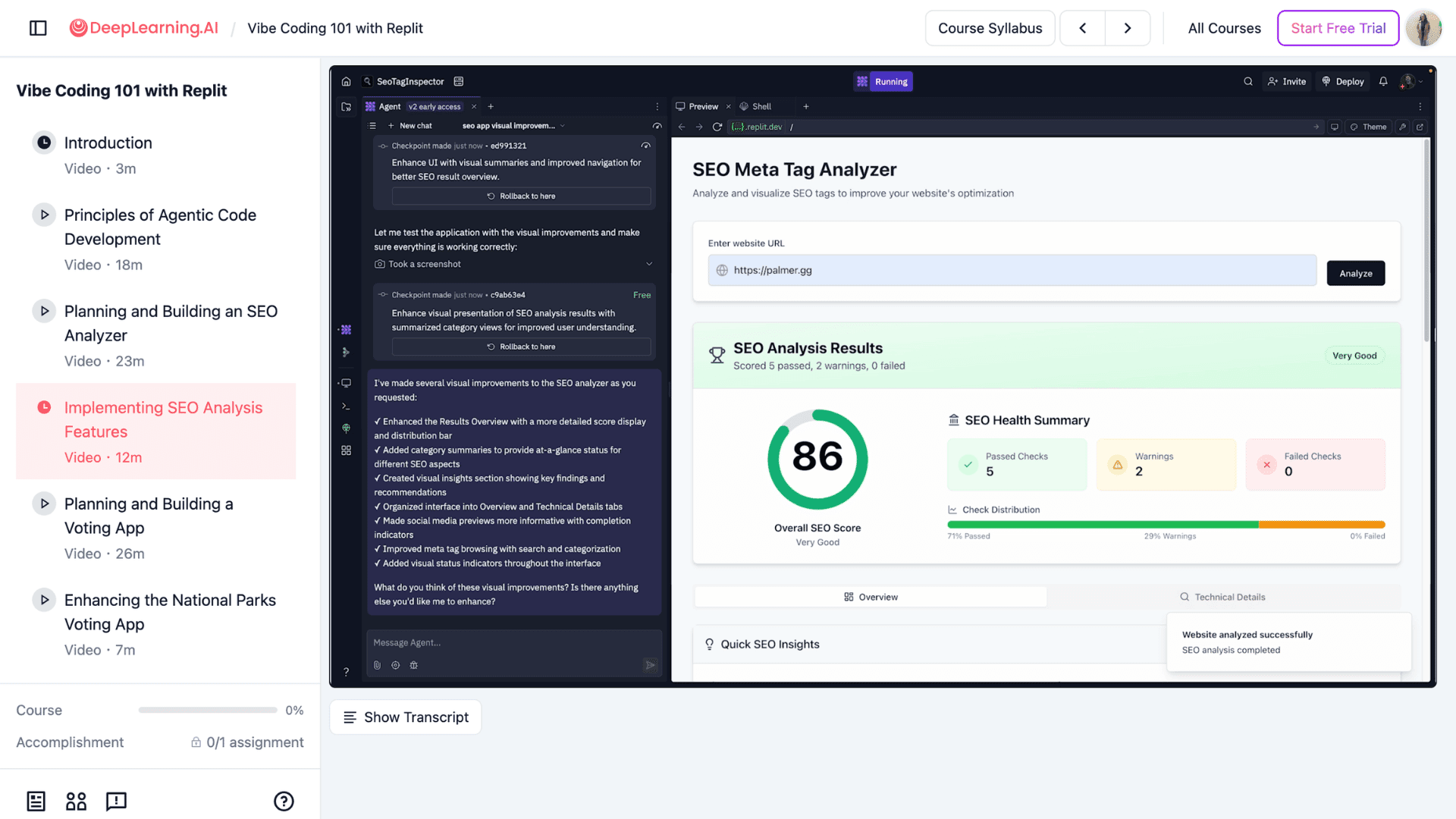
The learner will build at least two applications, a website performance analyzer and a voting app, throughout this course. It’ll also focus on teaching a “five-skill framework” for effective vibe coding. At the end of the course, you’ll have developed structured development habits, such as writing PRDs, creating wireframes, and crafting clearer prompts to guide an AI coding assistant.
I’d recommend this course because it gives a clear, low-friction path into software development. It is specifically useful for non-coders who want to make prototypes, internal tools, or simple apps without getting stuck on complex setup or syntax. More importantly, the course is not just conceptual; it encourages you to treat AI as a development collaborator, not just a code generator.
Keep in Mind
- This is a beginner-friendly app-building course, not an in-depth AI model-building program.
- The course teaches you how to use Replit effectively, but it doesn’t cover advanced topics, like backend architecture or system design.
Conclusion
This article rounds up the best free artificial intelligence courses for beginners. I’ve covered 13 free online courses across different categories, including AI fundamentals, prompt engineering, generative AI, AI agent building, and vibe coding. Together, these courses can help you go from understanding AI basics to working with LLMs, writing effective prompts, building AI agents, and automating workflows.
If you’re an absolute beginner, I’d recommend starting with foundational courses like Elements of AI or CS50x 2026 Artificial Intelligence. To gain practical AI skills, the Prompt Engineering course by OpenAI Academy and Google AI Essentials are great picks. For those looking for deep technical knowledge, the Hugging Face LLM and Agents courses and Andrej Karpathy’s LLM materials are worth exploring.
All the courses listed here are valuable and worth your time. But remember, the right course depends on your current skill level and what you want to do next. Non-coders should choose courses that explain AI in simple, easy-to-understand language, while aspiring developers should look for courses that cover model workflows, AI agents, and hands-on projects.
One honest caveat: free courses are great for learning what AI can and can’t do, but they don’t always show you how to use it in your day-to-day work. If you’ve taken a few and still don’t know what to type into ChatGPT, a structured programme focused on real work situations can help bridge that gap. AI For Working Professionals is one option, priced at ₹3,999, with 25% off using the code KRIPESH.
That’s all from my end! If I’ve missed any free AI courses that you’ve tried and found useful, let me know in the comments section. Until then, happy learning!