From content creation to education and business, AI is everywhere today! But at the heart of it all is AI prompting! You simply type in a few words, and boom, you get an instant output! When you tweak your words a little, the output changes dramatically!
Well, that’s the magic of prompting. And if you’ve been struggling to craft effective prompts to get the most out of AI tools, you’re in the right place!
In this article, I’ll walk you through the 7 Best Free AI Prompting Courses for 2026. These are ideal for beginners, intermediate users, and even seasoned professionals looking to sharpen their skills.
So, are you ready to unlock the true power of AI and write better prompts? Let’s get started!
7 Best Free AI Prompting Courses (2026)
| Course Name | Provider | Format & Duration | Level | Main focus | Certificate |
| ChatGPT for Everyone | Learn Prompting | Video course, ~1 hour | Beginner | ChatGPT basics, prompt writing, safe prompting | Paid certificate |
| Introduction to Prompt Engineering | OpenAI Academy | Single video, ~6 minutes | Beginner | Core prompt structure, prompting basics, model interaction | No |
| AI Prompting for Everyone | DeepLearning.AI | 21 lessons, 7 hours 4 minutes | Beginner to Intermediate | General prompting for everyday and professional use | Paid certificate |
| Prompt Engineering for ChatGPT | Coursera / Vanderbilt | 6 modules, self-paced | Beginner to Intermediate | ChatGPT prompting patterns, refinement, prompt design | Paid certificate |
| Generative AI: Prompt Engineering Basics | Coursera | 3 modules + 11 labs, self-paced | Beginner | Prompt fundamentals for generative AI | Paid credential |
| Advanced Prompt Engineering | OpenAI Academy | Single video, ~ 9 minutes | Advanced | Advanced prompt design, refinement, and performance improvement | No |
| ChatGPT Prompt Engineering for Developers | DeepLearning.AI x OpenAI | Jupyter notebook course, self-paced | Intermediate to Advanced | API-based prompting, prompt iteration, LLM application workflows | Paid accomplishments |
7 Best Free AI Prompting Courses
1) ChatGPT for Everyone
| Offered By | Learn Prompting (OpenAI collaboration) |
| Category | ChatGPT Fundamentals |
| Format/duration | Self-paced short course |
| Content | ChatGPT account setup, writing your first prompt, everyday use cases (writing, brainstorming, tutoring), basics of prompt crafting, DALL·E 3 basics, and AI safety/limitations |
| Certificate | Free to learn; certificate requires Learn Prompting Plus subscription |
ChatGPT for Everyone is a one-hour self-paced course designed for absolute beginners. More than 200K+ learners around the world have already completed this course. It’s offered by Learn Prompting, in collaboration with OpenAI.
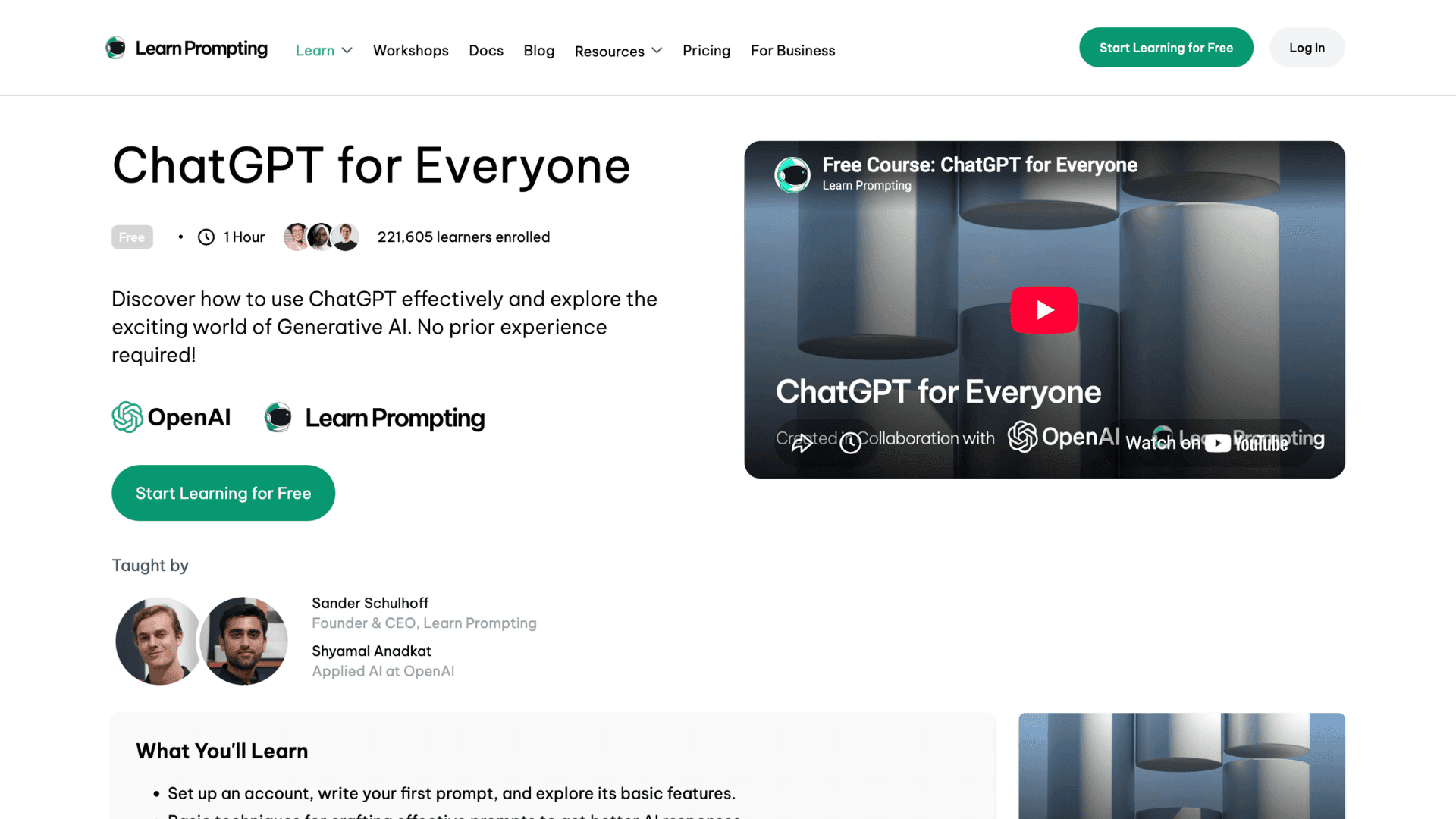
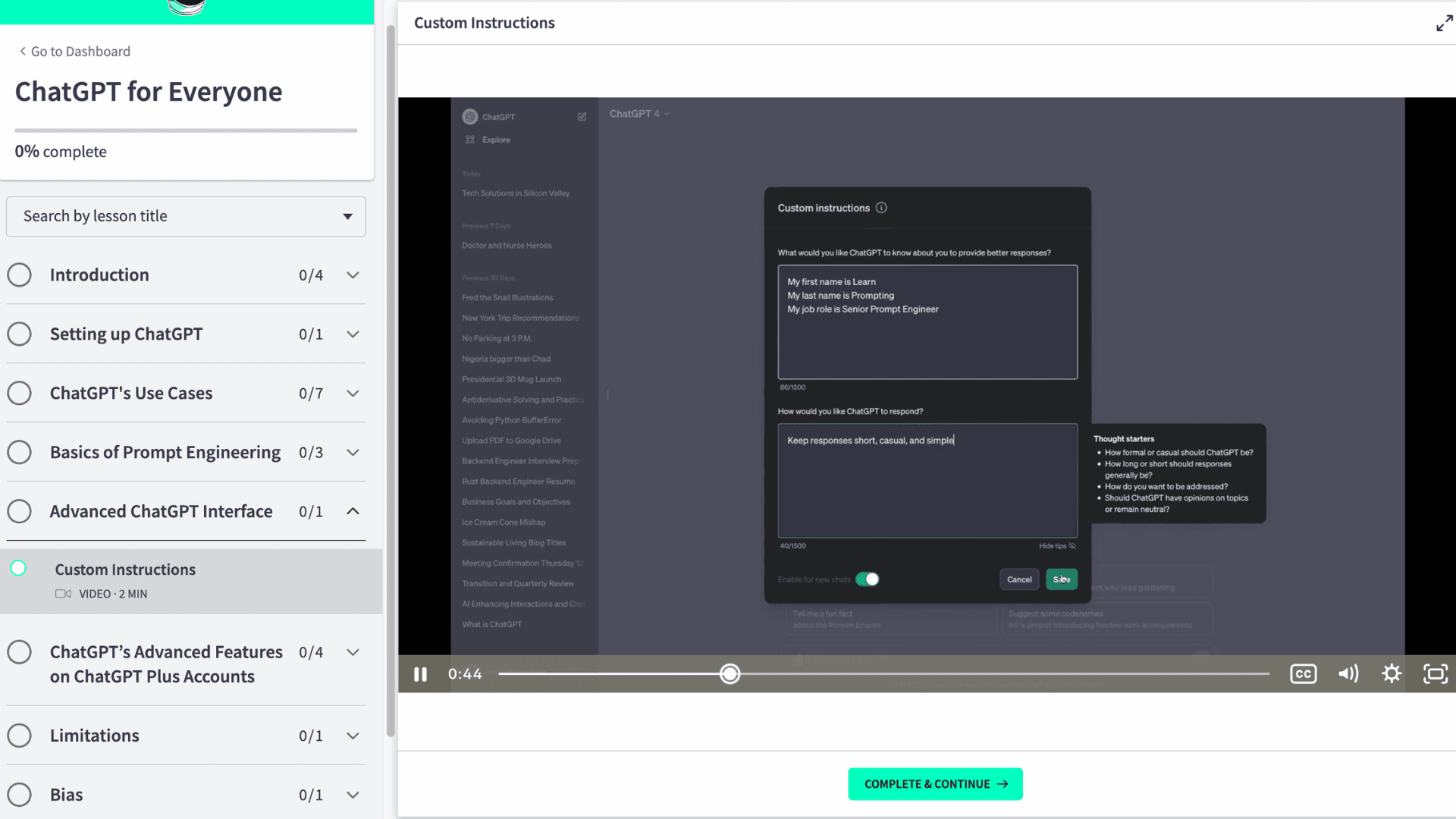
The course includes multiple short videos divided into different sections, such as the introduction, setting up ChatGPT, the basics of prompt engineering, the advanced ChatGPT interface, and more. It starts with the fundamentals of ChatGPT and shows you how to use it for everyday tasks like writing emails, brainstorming ideas, and automating repetitive work.
You’ll also learn the basics of prompt writing, explore ChatGPT’s multimodal and creative features, write simple DALL·E 3 prompts, and understand AI safety, limitations, and best practices. I picked this course because it focuses on practical, everyday use cases. Busy professionals can easily finish it over a weekend.
One thing: the course is framed only for ChatGPT, not other LLMs like Claude, Gemini, etc. Another downside is that you don’t get a certificate for free. To earn a certificate, you need to upgrade to the paid subscription for $21/month.
Overall, if you’ve never used ChatGPT before, this is a great course to get started with.
2) Introduction to Prompt Engineering
| Offered By | OpenAI Academy |
| Category | Workplace & Business / ChatGPT Foundation |
| Format/duration | Short video lesson/module |
| Content | Core prompt-writing principles for getting more useful ChatGPT responses in day-to-day work |
| Certificate | None |
If you’ve already completed the first course, Introduction to Prompt Engineering by OpenAI Academy is the perfect next step. Instead of just learning how to use ChatGPT, you’ll start understanding how to write better instructions for AI models. It’s a short lesson that takes just 6 minutes to complete.
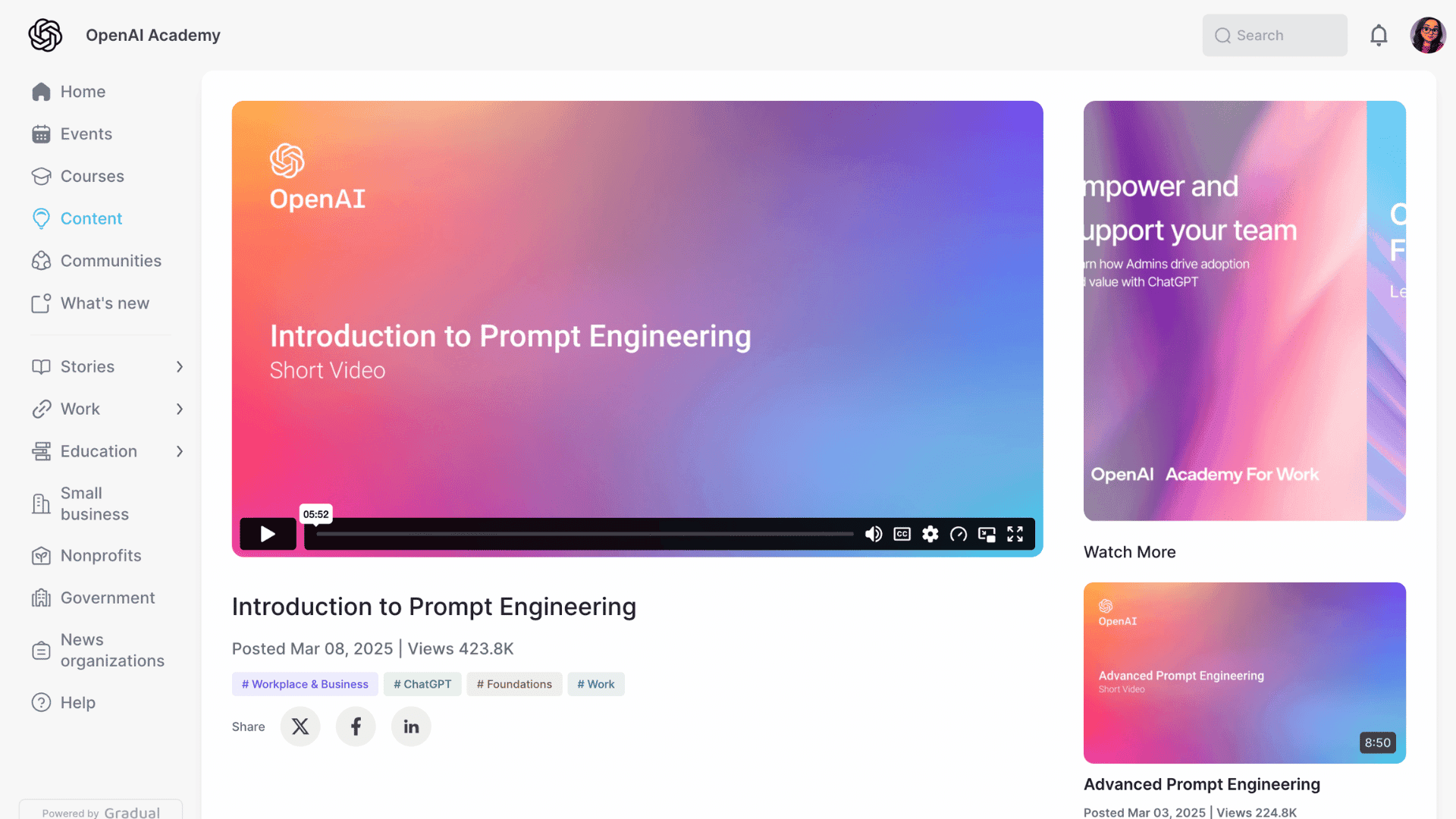
The video thoroughly explains what prompt engineering is, how to control AI model outputs, and what the key components of good-quality prompts are. You’ll learn to define the output format, break complex tasks into small subtasks, or ask the model to apply multi-step logic.
It also helps you recognize why and how AI models hallucinate, and how much longer prompts and context windows can affect performance. Basically, the course is short but focused. But it only covers fundamentals, so you’ll need to move on to more advanced guides later.
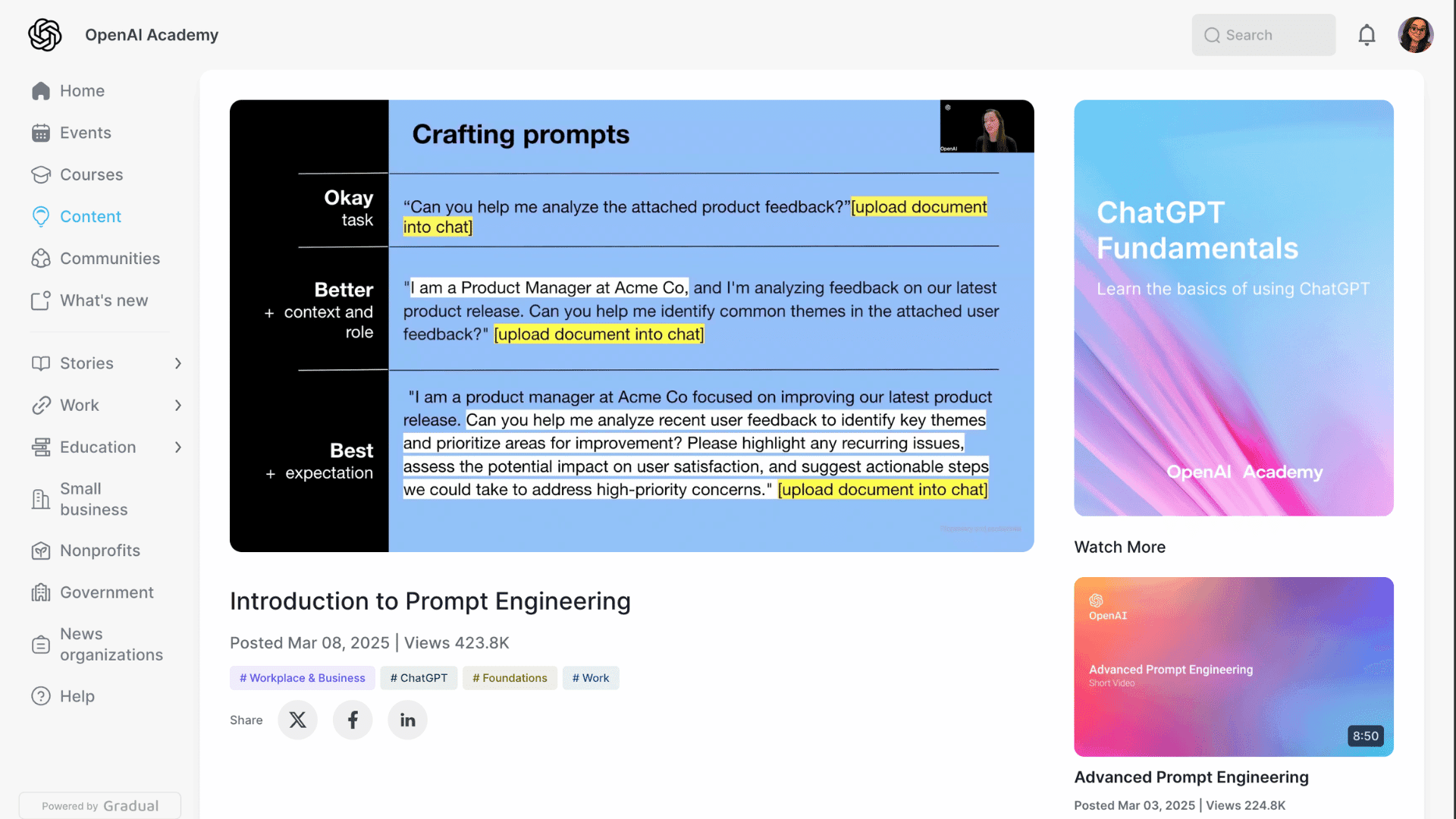
I’d say the Prompt Engineering introduction from OpenAI is a course every serious ChatGPT user should watch at least once.
3) AI Prompting for Everyone
| Offered By | DeepLearning.AI, taught by Andrew Ng |
| Category | Practical AI Literacy / No-Code Prompting |
| Format/duration | Self-paced course |
| Content | Modern prompting workflows, including when to use deep research modes, recognizing AI sycophancy, image generation prompting, and building simple no-code AI apps |
| Certificate | Course content free; certificate requires a DeepLearning.AI Pro membership |
AI Prompting for Everyone is DeepLearning.AI’s newest prompting course that fills the gap between casual prompting and structured practice. The course is taught by Andrew Ng, one of the most well-known educators in AI. It helps you understand how prompting has evolved, from the way people used ChatGPT in 2022 to how modern AI models should be prompted today.
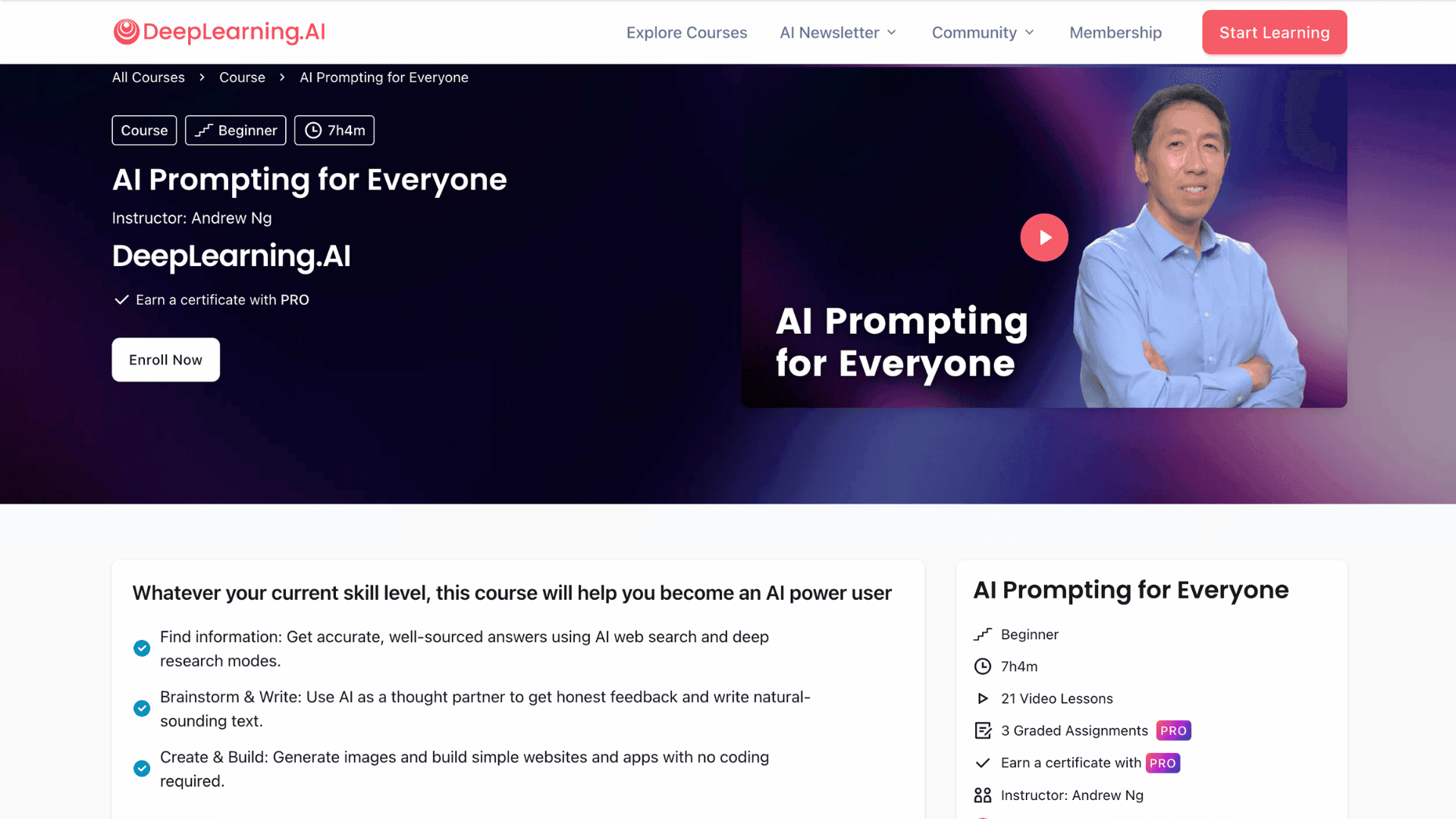
The course runs for 7 hours and 4 minutes across 3 modules. It starts by explaining the difference between what an AI model already knows and when it needs to search the web for information. You’ll learn how to use AI web search, when to use deep research mode, and how to get more reliable answers.
Next, the course shows how to use AI as a thought partner for brainstorming, problem-solving, and reasoning through ideas. The final module focuses on working with multimedia and code using AI. Each module also includes hands-on labs to help you practice what you’ve learned.
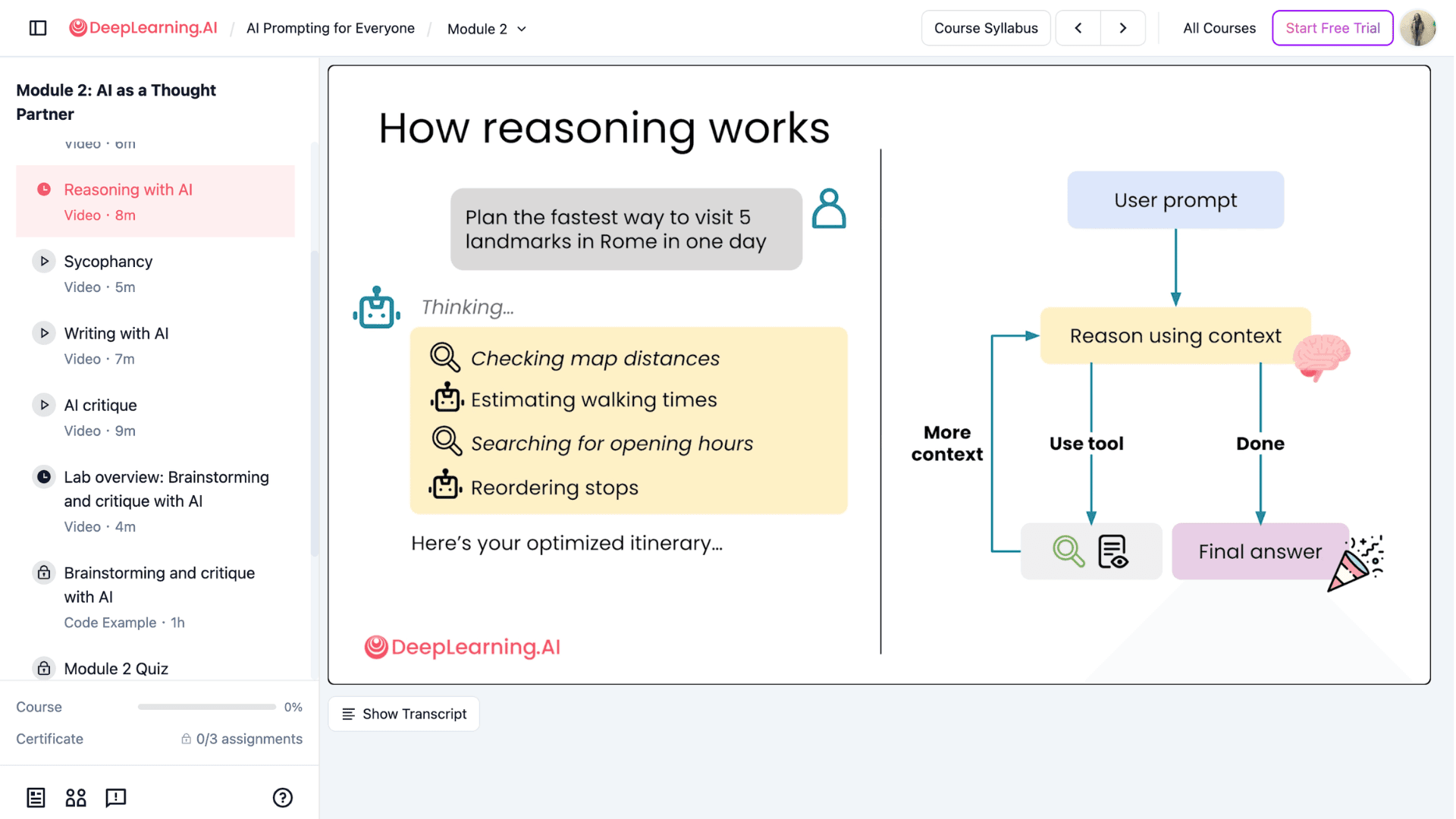
I’d recommend this course to almost everyone because it covers many of the latest AI topics. Knowledge of deep research modes, AI sycophancy recognition, and no-code app building is highly relevant today. The only downside is that free users can’t access some lessons, hands-on labs, and quizzes, as they require a DeepLearning.AI Pro subscription.
Overall, this course is a great choice if you want to learn how to use not just ChatGPT, but also Claude, Gemini, and other modern AI models in your daily work.
4) Prompt Engineering for ChatGPT
| Offered By | Coursera, Vanderbilt University, taught by Dr. Jules White |
| Category | Structured Prompt Patterns / Applied Generative AI |
| Format/duration | Multi-week Coursera format |
| Content | Prompt patterns including persona, few-shot, chain-of-thought, and ReAct, building toward a capstone prompt-based application |
| Certificate | Free to audit; certificate is paid |
Prompt Engineering for ChatGPT is a flagship course offered by Vanderbilt University on Coursera. If you’re looking for a structured, university-backed course on AI prompting, this is one of the best options. It’s taught by Dr. Jules White, one of the top instructors in this space, and already 700K+ learners have enrolled.
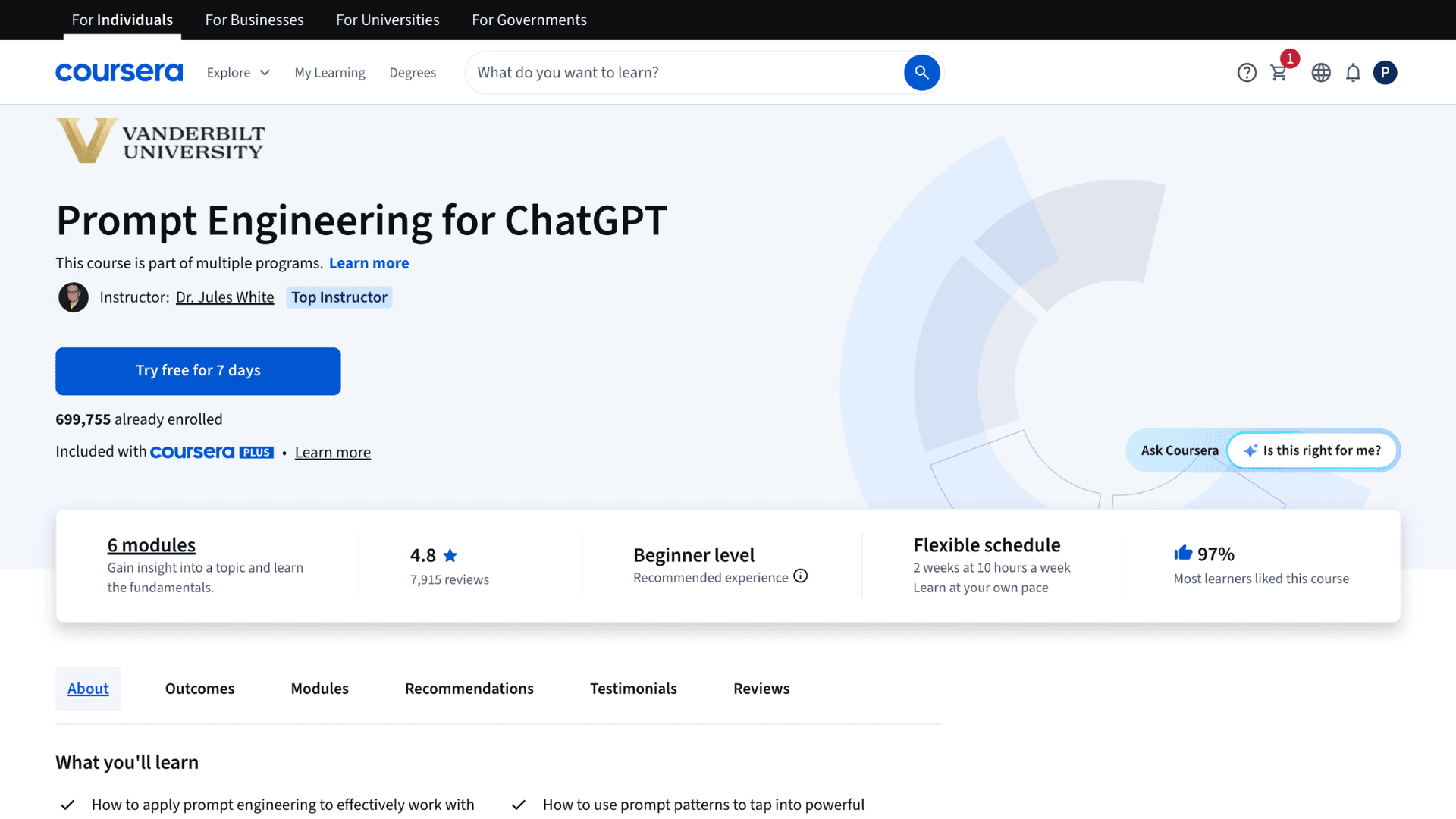
This course walks you through 6 modules. Module 1 starts with the basics of prompts, different prompt patterns, and real-world examples. As you progress, you’ll learn how to build prompt-based applications that can simplify tasks in your personal life, education, and business.
By the end, you’ll be able to understand how to apply prompt engineering techniques to LLMs, identify different prompt patterns, and create more advanced prompt-based workflows. The course covers popular topics like Chain of Thought prompting, ReAct prompting, Meta Language Creation Pattern, etc.
Prompt Engineering for ChatGPT isn’t just conceptual, like the OpenAI or Learn Prompting course. It provides 15 different prompt examples. Every module includes quizzes and assignments. The course ends with a capstone project of building a prompt-based app.
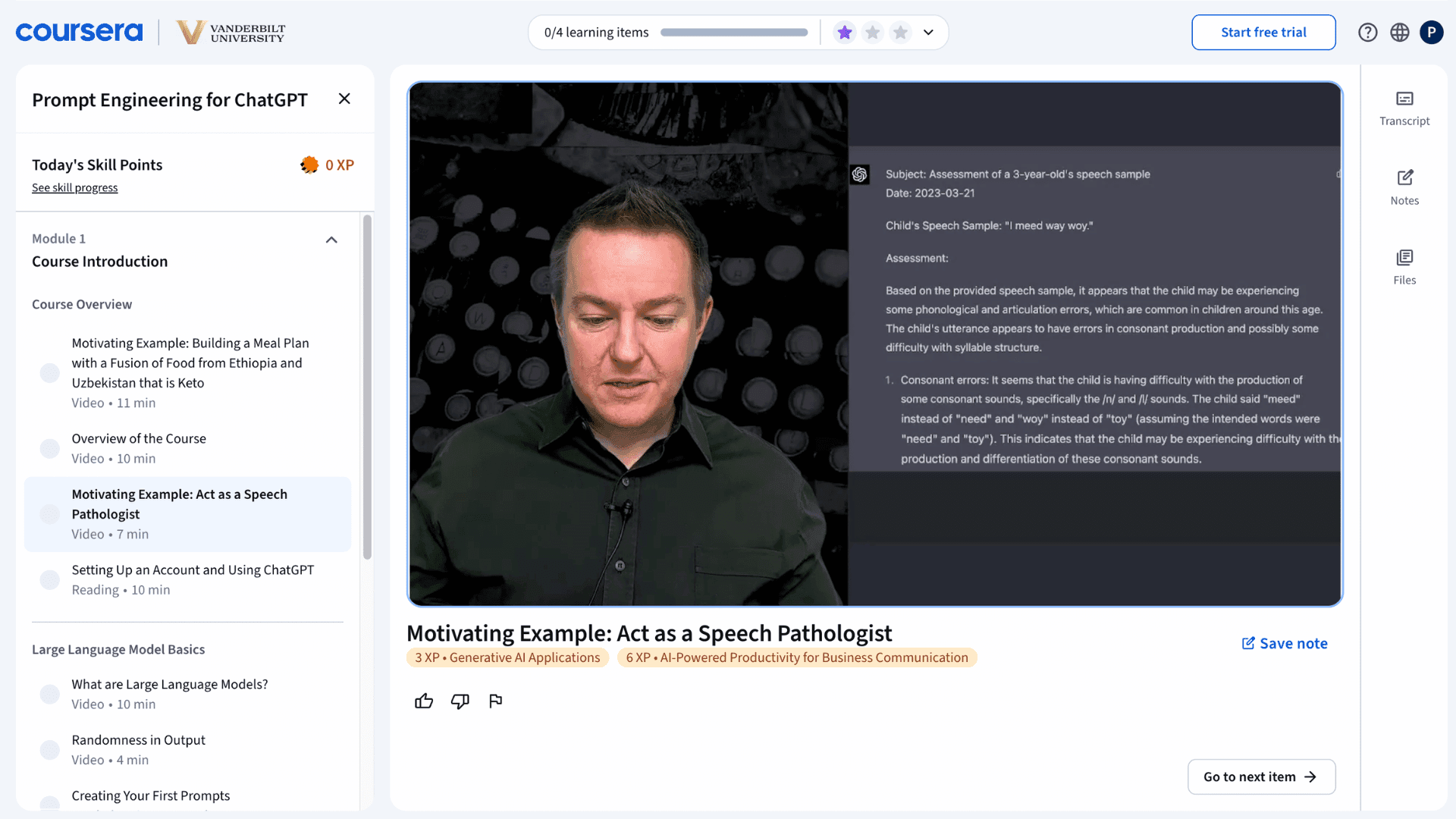
But the course needs a more disciplined approach and time commitment, as you’ll only have 7 days to finish it during the free trial period. It’s not for quick learners. Also, certificates of completion are only available for paid plans.
So, if you’re preparing for an AI-related job role, do check it out!
5) Generative AI: Prompt Engineering Basics
| Offered By | Coursera, IBM |
| Category | Structured Prompt Patterns / Applied Generative AI |
| Format/duration | Coursera course format |
| Content | Zero-shot and few-shot prompting, the interview pattern, chain-of-thought and tree-of-thought reasoning, and multimodal prompting, reinforced through 11 hands-on labs |
| Certificate | Free to audit; certificate is paid |
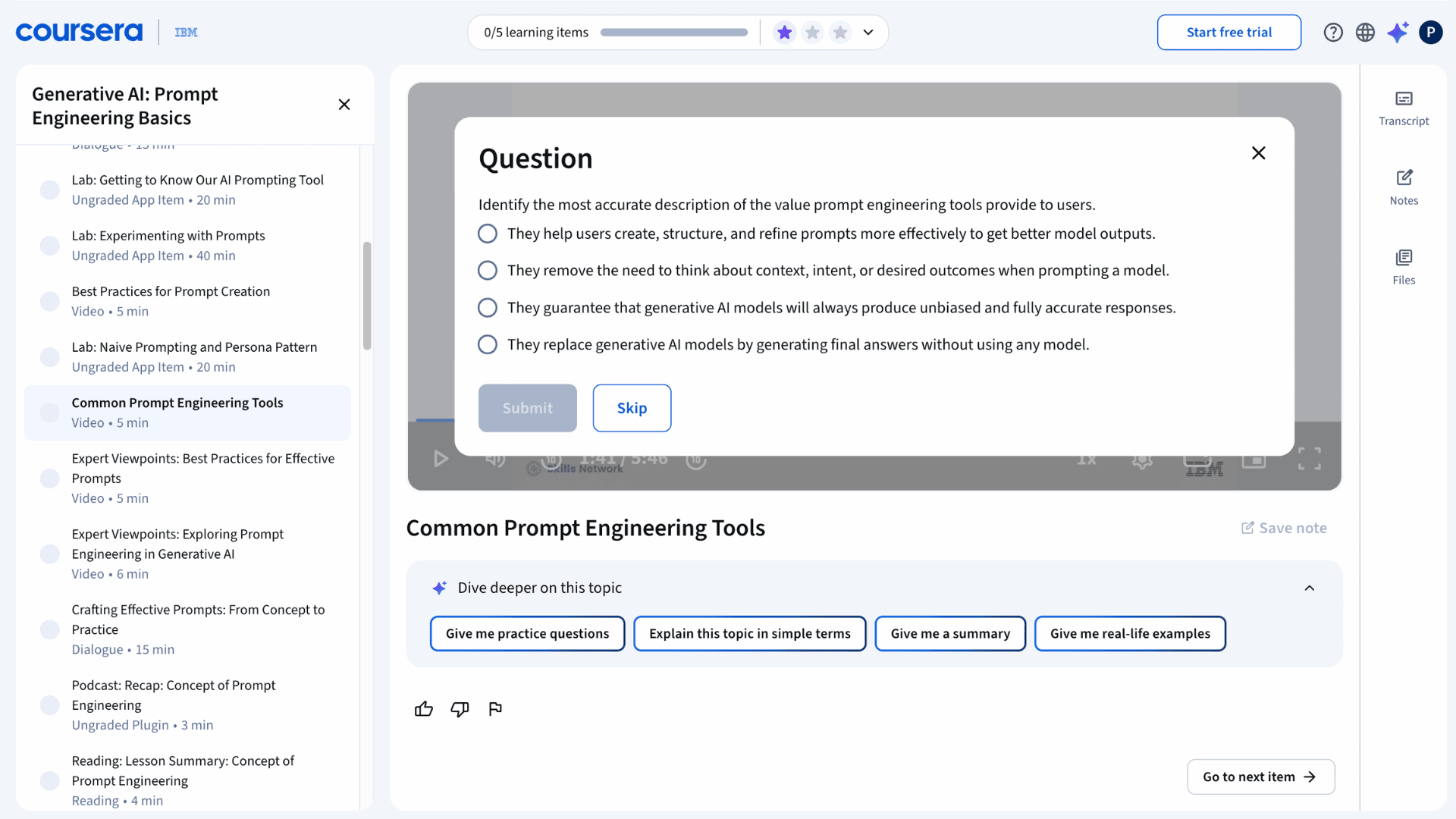
Generative AI Prompt Engineering Basics is IBM’s entry-level prompting course. It currently has over 650k learners and a 4.7-star rating. The course is taught by experienced IBM instructors Antonio Cangiano and Rav Ahuja.
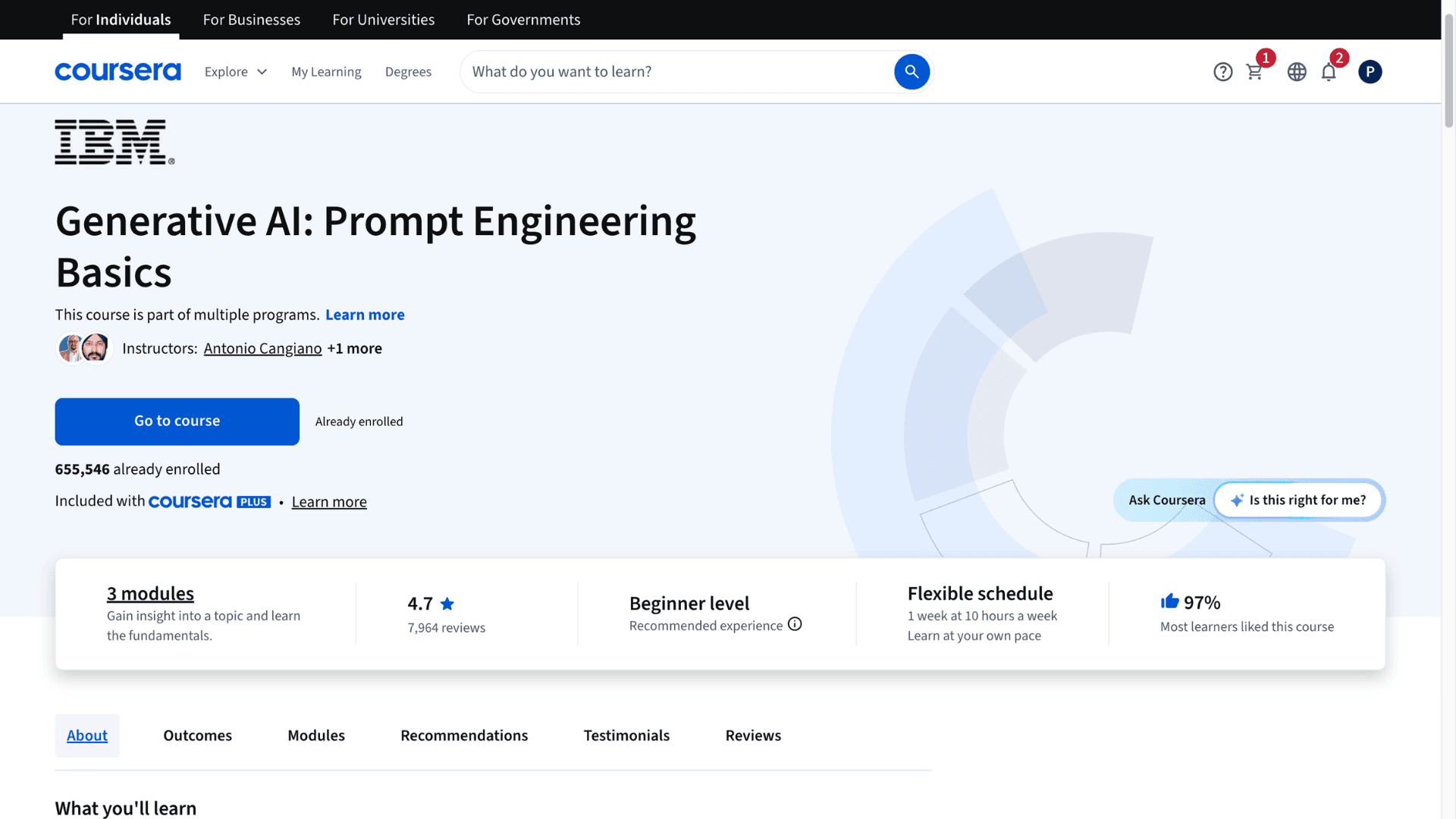
The course is compact with 3 modules and roughly takes 7 to 9 hours total. You’ll get to learn the basic concepts and best practices of prompt writing. It also covers methods like text-to-text prompting, the Interview Pattern, Chain-of-Thought prompting, and Tree of Thoughts, along with hands-on labs to help you practice.
As a beginner, you should do this course because it focuses on practical learning rather than just theory. The course is backed by IBM, so great for corporate credibility.
The only concern is that you won’t get a certificate for free. Overall, this course is a great choice for non-technical learners who want a structured, practical introduction to prompt engineering from industry experts.
6) Advanced Prompt Engineering
| Offered By | OpenAI Academy |
| Category | Workplace & Business / ChatGPT Advanced & Builder Skills |
| Format/duration | Short video module |
| Content | More sophisticated prompting approaches for builders and power users beyond the basics covered in the Introduction video |
| Certificate | None |
Once you’re done with Introduction to Prompt Engineering, you can continue with OpenAI Academy’s next course, Advanced Prompt Engineering. It’s a short video lesson that covers advanced prompting concepts. If you already understand the basics of prompt engineering and prompt structures, you can jump straight into this course.
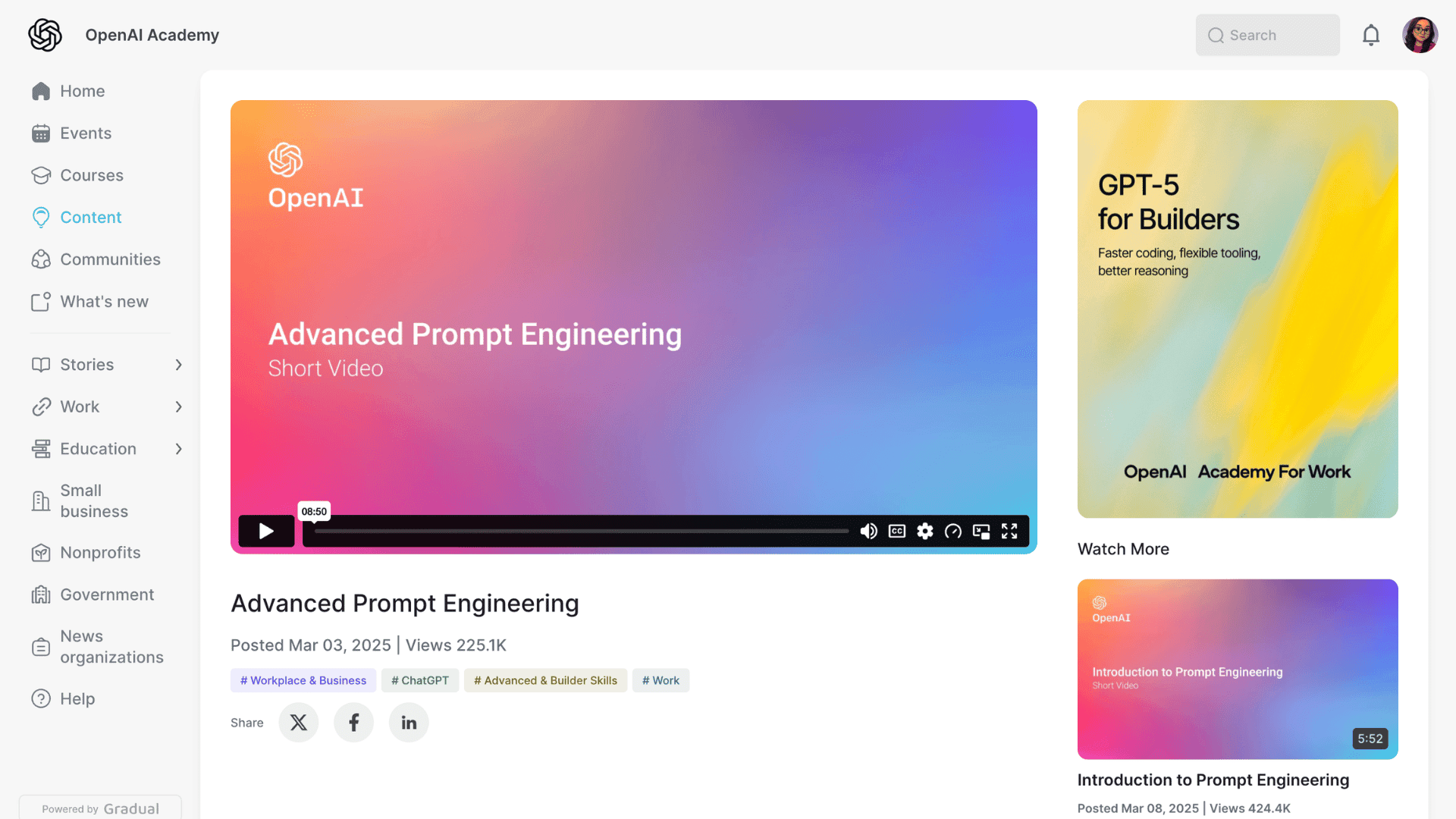
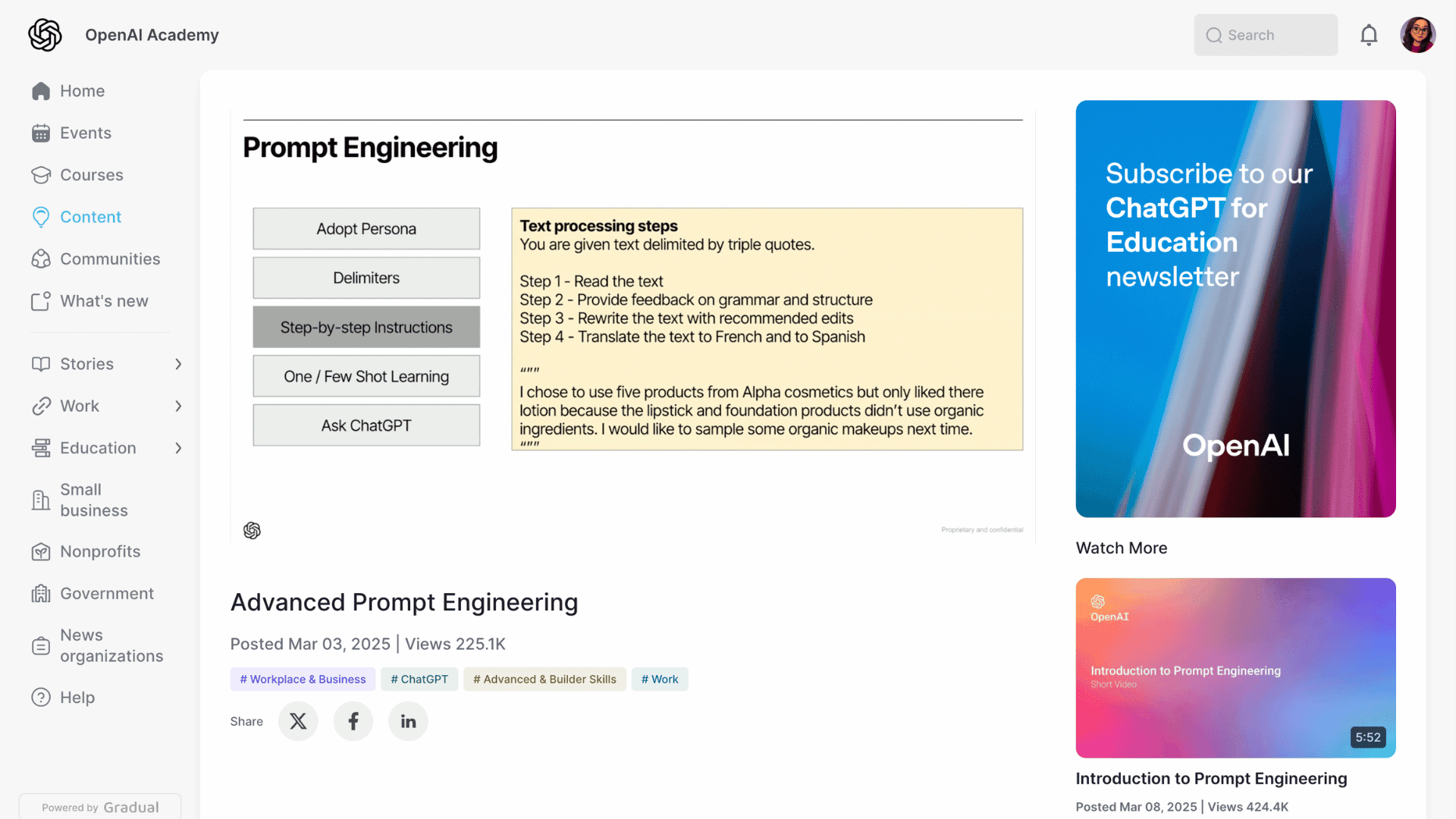
Unlike the previous course, this one consists of a single 9-minute video instead of multiple modules. The lessons cover several advanced techniques, including designing complex prompts, using iterative prompting to refine outputs, generating JSON-style structured responses, and understanding how prompts interact with tools. You’ll also learn how to create reusable prompts and separate instructions from data to make your prompts more reliable and maintainable.
A big advantage is that it incorporates OpenAI’s latest guidance for GPT-4-class models. I recommend this to intermediate and advanced learners because it introduces concepts like multi-step reasoning, structured outputs, and prompt organization. These skills are useful for data analysts, content strategists, product managers, and developers.
But the course does not include projects or exercises. Also, most of the prompt engineering techniques are designed for OpenAI’s models.
7) ChatGPT Prompt Engineering for Developers
| Offered By | DeepLearning.AI, in partnership with OpenAI, taught by Isa Fulford (OpenAI) and Andrew Ng |
| Category | Developer / API-Based Prompt Engineering |
| Format/duration | Short course / hands-on developer lesson series |
| Content | Prompting techniques applied through live OpenAI API calls in Jupyter notebooks include summarizing, inferring, transforming, and expanding text programmatically |
| Certificate | Free to audit; paid accomplishments with Pro subscription |
ChatGPT Prompt Engineering for Developers is another excellent AI prompting course from DeepLearning AI that I would recommend. The course has been created in collaboration with OpenAI. Isa Fulford from OpenAI and Andrew Ng from DeepLearning AI will teach us, so you can expect practical insights from two leading experts in the field!
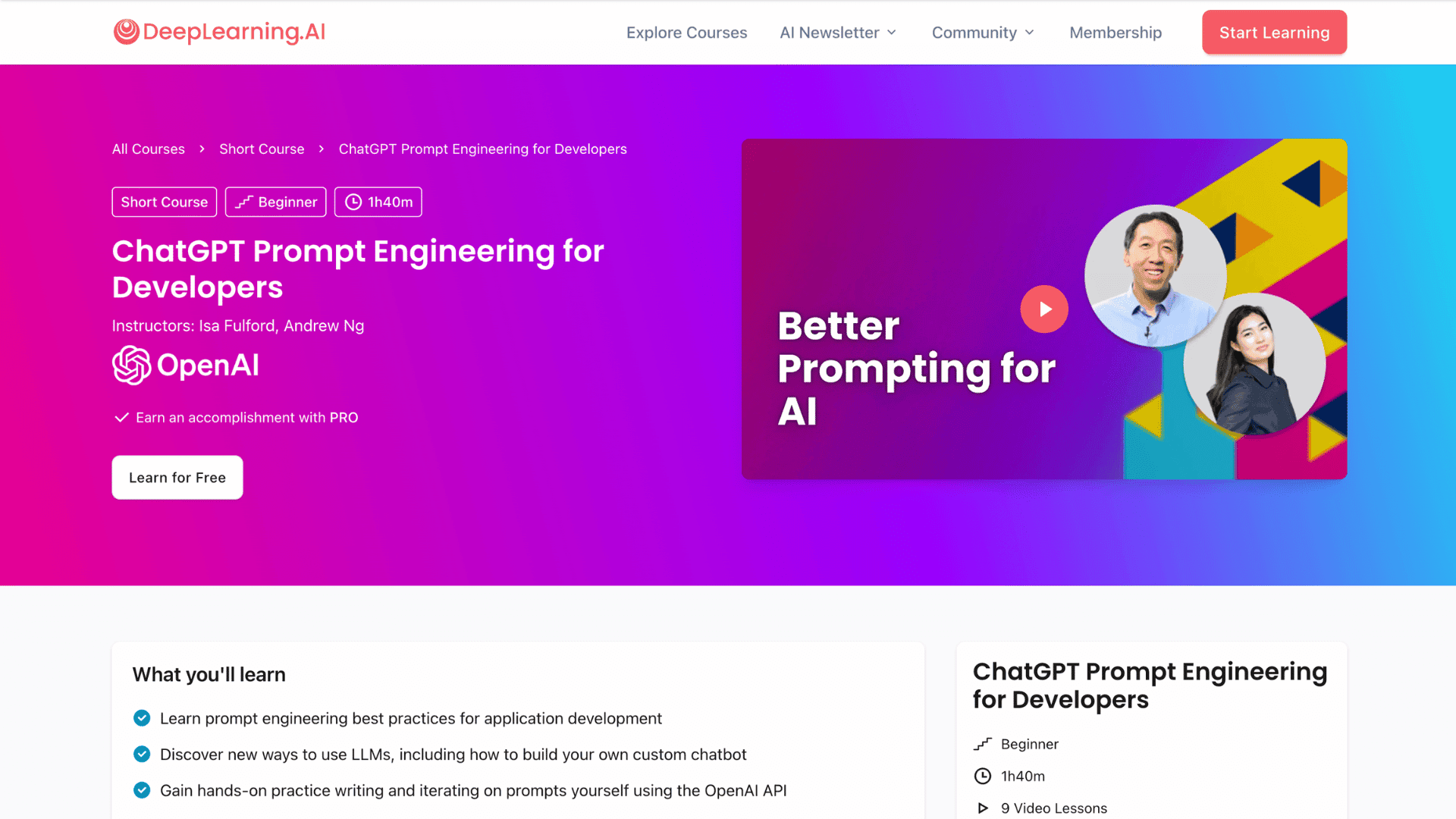
The course is around 1 hour and 40 minutes long and includes videos, coding examples, quizzes, etc. Since it focuses on building AI-powered applications, you’ll need a basic understanding of Python before getting started.
It starts by covering the fundamentals of prompt engineering, why prompt engineering is important for AI app development, and core prompting principles. From there, the course moves into iterative prompt development with practical examples of debugging, sentiment analysis, topic extraction, instruction-based prompts, and more. Toward the end, you’ll also build a custom chatbot using the OpenAI API.
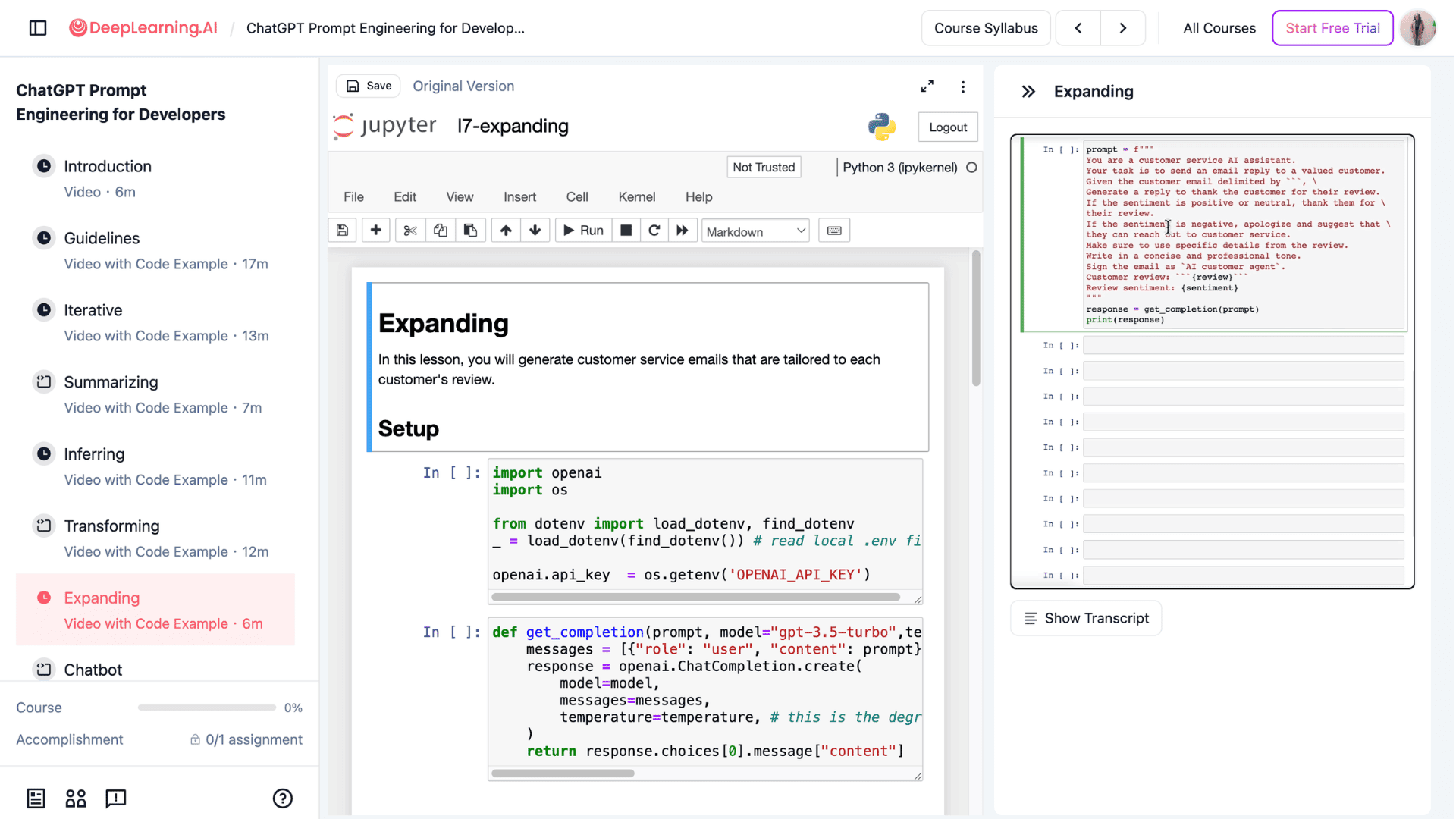
This course isn’t conceptual but code-based and project-oriented. However, you won’t get a certificate on completing this course. If you are a software developer or a programmer interested in learning prompt engineering, give this course a try!
If you’re not a developer and work in sales, HR, operations, or finance, you probably want prompting that applies to your actual work and inbox, not app development. In that case, the free courses above may feel a little abstract. A paid, non-technical option worth considering is AI For Working Professionals, which teaches prompting through real workplace situations rather than tool-by-tool. It costs ₹3,999, with 25% off using the code KRIPESH.
Bonus: AI Image Prompting Guide by Let’s Enhance
Now that you’ve followed through with me to the end of the article, I have a bonus recommendation for you! It’s an AI Image Prompting Guide by Let’s Enhance.
Most people today struggle with generating good images with AI. Whether you’re a beginner or a professional, this guide will teach you the basics of writing good image prompts. I loved the way it clarifies concepts using visual examples.
This guide can help you create captivating images with Midjourney, Dall-E, Stable Diffusion, Flux, and other models. So, if you are a graphic designer, content creator, or social media enthusiast, you’ll find it valuable.
Why Should You Learn AI Prompting?
Today, the world revolves around artificial intelligence. With tools like ChatGPT, Gemini, and Midjourney becoming commonplace, AI prompting is quickly becoming a valuable skill. Let’s explore why you should consider learning AI prompting.
1) More Control Over AI Tools
Are you tired of getting generic outputs from AI tools? Well, learning the art of AI prompting can help you get more precise and accurate results. This skill can help you understand the ways to tweak your prompts to produce effective outcomes.
2) Boosts Productivity
Whether you are a student or a professional, learning the art of AI prompting can help you save a ton of time. You can easily create content, draft emails, perform research, generate summaries, and even create images in seconds.
3) Remain Competitive in the Job Market
You may have noticed that employers are seeking candidates who have a command of AI skills. AI prompting is becoming a desirable skill in fields like education, technology, marketing, management, etc. Learning this valuable skill can help you stand out amongst your competitors.
Conclusion
In this article, we explored seven Best Free AI Prompting Courses available in 2026. If you’re completely new to AI prompting, ChatGPT for Everyone by Learn Prompting is an excellent place to start. But if you’re short on time, Introduction to Prompt Engineering and Advanced Prompt Engineering by OpenAI Academy are two short video courses that make great supplements.
For learners who want real depth, AI Prompting for Everyone and ChatGPT Prompt Engineering for Developers by DeepLearning.AI remain the gold standard. Ultimately, there’s no single “best” course; the right choice depends on your background, learning style, and goals.
To broaden your AI knowledge beyond prompting, you can also explore my curated list of the 13 Best Free AI Courses for Beginners. It features courses from leading institutions like Google, Harvard, IBM, Microsoft, and more.
I hope this guide helped you find the perfect course to enhance your learning, whether you’re just starting or are an AI professional dealing with advanced concepts. So, which course from our list caught your attention? Share with me in the comments section below.
This is Kripesh, signing off. I’ll be back soon with more insightful articles. Cheers. 🙂